ANGKOR WAT · OVERVIEW
Angkor Wat is a Theravada Buddhist temple complex, originally built as a Vaishnava Hindu temple, in Siem Reap, Cambodia. It is the largest religious complex in the world. Located on a site measuring 162.6 hectares within the medieval capital of Angkor, it was constructed between 1113 and 1150 CE during the reign of the Khmer king Suryavarman II as a Hindu temple dedicated to Vishnu. From the late 13th century onward, the complex was gradually transformed into a Buddhist temple as Khmer kings adopted Buddhism. Angkor Wat has remained a Buddhist monastery and an active center of Buddhist worship into the present day. It is noted for its monumental scale, extensive bas-reliefs, and an architectural unity characteristic of Khmer architecture. Unlike most Angkorian temples, it is oriented toward the west. It is a symbol of Cambodia and appears on the Cambodian national flag.
LOCATION ·
13.41250, 103.86667
World Heritage Record
Inscribed on the UNESCO World Heritage List in 1992. World Heritage criteria: (i)(ii)(iii)(iv). Official property area: 40,100 ha.
SOURCE · UNESCO World Heritage Centre
Outstanding Universal Value
Angkor, in Cambodia’s northern province of Siem Reap, is one of the most important archaeological sites of Southeast Asia. It extends over approximately 400 square kilometres and consists of scores of temples, hydraulic structures (basins, dykes, reservoirs, canals) as well as communication routes. For several centuries Angkor, was the centre of the Khmer Kingdom.
SOURCE · UNESCO World Heritage Centre
Integrity & Condition
The Angkor complex encompasses all major architectural buildings and hydrological engineering systems from the Khmer period and most of these “barays” and canals still exist today. All the individual aspects illustrate the intactness of the site very much reflecting the splendor of the cities that once were. The site integrity however, is put under dual pressures: endogenous: exerted by more than 100,000 inhabitants distributed over 112 historic settlements scattered over the site, who constantly try to expand their dwelling areas; exogenous: related to the proximity of the town of Siem Reap, the seat of the province and a tourism hub.
SOURCE · UNESCO World Heritage Centre
Authenticity
Previous conservation and restoration works at Angkor between 1907 and 1992, especially by the École Française d’Extrême-Orient (EFEO), the Archaeological Survey of India, the Polish conservation body PKZ, and the World Monuments Fund have had no significant impact on the overall authenticity of the monuments that make up the Angkor complex and do not obtrude upon the overall impression gained from individual monuments.
SOURCE · UNESCO World Heritage Centre
Protection & Management
The property is legally protected by the Royal Decree on the Zoning of the Region of Siem Reap/Angkor adopted on 28 May 1994 and the Law on the protection of the natural and cultural heritage promulgated on 25 January 1996, the Royal Decree on the creation of the APSARA National Authority (Authority for the protection of the site and the management of the Angkor Region) adopted on 19 February 1995, the No. 70 SSR government Decision, dated 16 September 2004 providing for land‐use in the Angkor Park: “All lands located in zone 1 and 2 of the Angkor site are State properties”, and the sub-decree No. 50 ANK/BK on the organisation and functioning of the APSARA National Authority adopted on 9 May 2008, specifically provided for the establishment of a Department of Land‐use and Habitat Management in the Angkor Park.
SOURCE · UNESCO World Heritage Centre
Restoration and conservation challenges
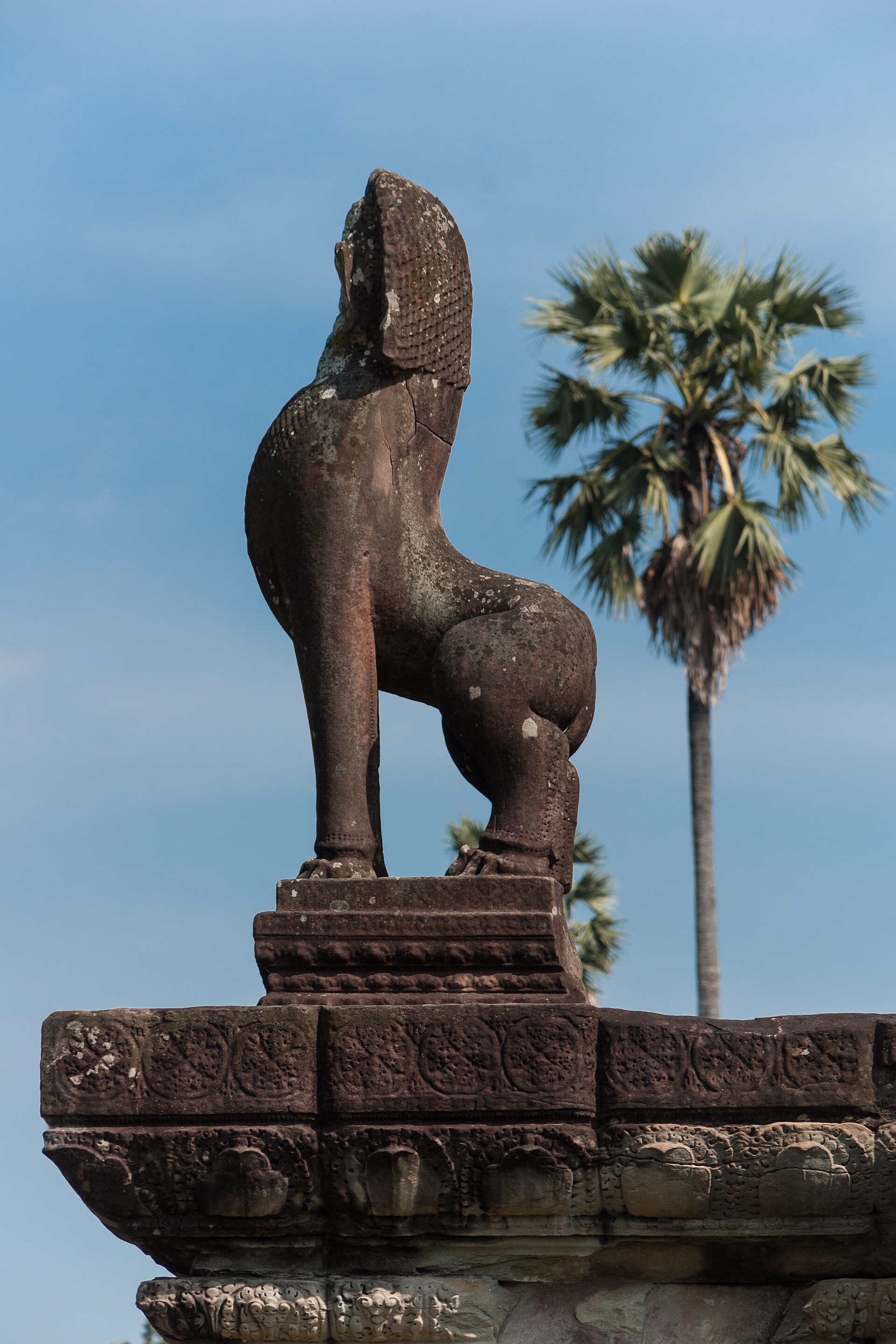
[ edit ] In the 20th century, a considerable effort was launched to clear the plant overgrowth and restore the temple complex. Conservation d'Angkor (Angkor Conservancy) was established by the École française d'Extrême-Orient (EFEO) in 1908. The Conservation d'Angkor was responsible for the research, conservation, and restoration activities carried out at Angkor until the early 1970s with major restoration works undertaken in the 1960s. Bullet holes left by a shoot-out between the Khmer Rouge and Vietnamese forces at Angkor Wat Restoration work was interrupted by the Cambodian Civil War when the Khmer Rouge took control of the country during the 1970s and 1980s. Work on Angkor was abandoned during the Khmer Rouge era and the Conservation d'Angkor was disbanded in 1975. Camping Khmer Rouge forces used whatever wood remained in the building structures for firewood, and a shoot-out between Khmer Rouge and Vietnamese forces caused a few bullet holes in bas reliefs. In the late 1980s and early 1990s, far more damage was done to the reliefs by art thieves working out of Cambodia who lopped off many sculptures and other structures, including earlier reconstructions. As with most other ancient temples in Cambodia, Angkor Wat also faced extensive damage and deterioration by a combination of plant overgrowth, fungi, ground movements, war damage, and theft, though the war damage to Angkor Wat's temples was limited compared to the rest of Cambodia's temple ruins. The restored head of a nāga beside an unrestored lion sculpture leading to the entrance of Angkor Wat Between 1986 and 1992, the Archaeological Survey of India carried out restoration work on the temple as France did not recognise the Cambodian government at the time. Criticisms have been raised about both the early French restoration attempts and the later Indian work, with concerns over the damage done to the stone surface by the use of various chemicals and cement. In 1992, the site was declared as a UNESCO World Heritage Site . Simultaneously, Angkor Wat was listed in UNESCO's World Heritage in Danger (later removed in 2004) following an appeal for help by Norodom Sihanouk together with an appeal by UNESCO to t
Tourism
[ edit ] See also: Tourism in Cambodia Buddhist monks at Angkor Wat Since the 1990s, Angkor Wat has become a major tourist destination. In 1993, there were only 7,650 visitors to the site and by 2004, government figures show that 561,000 foreign visitors had arrived in Siem Reap province that year, approximately 50% of all foreign tourists in Cambodia. The number reached over a million in 2007 and over two million by 2012. Angkor Wat received over two million foreign tourists in 2013 and 2.6 million by 2018. The site was managed by SOKIMEX between 1990 and 2016, which rented it from the Cambodian government . The influx of tourists has caused damage such as graffiti on the walls. Ropes and wooden steps have been introduced to protect the bas-reliefs and floors, respectively. Tourism has also provided some additional funds for maintenance — as of 2000 approximately 28% of ticket revenues across the entire Angkor site was spent on the temples — although most work is carried out by teams sponsored by foreign governments rather than by the Cambodian authorities. Since Angkor Wat has seen significant growth in tourism throughout the years, UNESCO and its International Co-ordinating Committee for the Safeguarding and Development of the Historic Site of Angkor (ICC), in association with representatives from the Royal Government and APSARA, organised seminars to discuss the concept of "cultural tourism", emphasising the importance of providing high-quality accommodation and services to the tourists and for the Cambodian government to benefit economically, while also incorporating and protecting the richness of Cambodian culture. In 2001, this incentive resulted in the concept of the "Angkor Tourist City " which would be developed about traditional Khmer architecture, contain leisure and tourist facilities, and provide luxurious hotels capable of accommodating large numbers of tourists. Angkor Wat with its reflection in the outer pool The prospect of developing such large tourist accommodations has encountered concerns from both APSARA and the ICC, claiming that previous tourism developments in the area have neglected construction regulations and that more of these proje