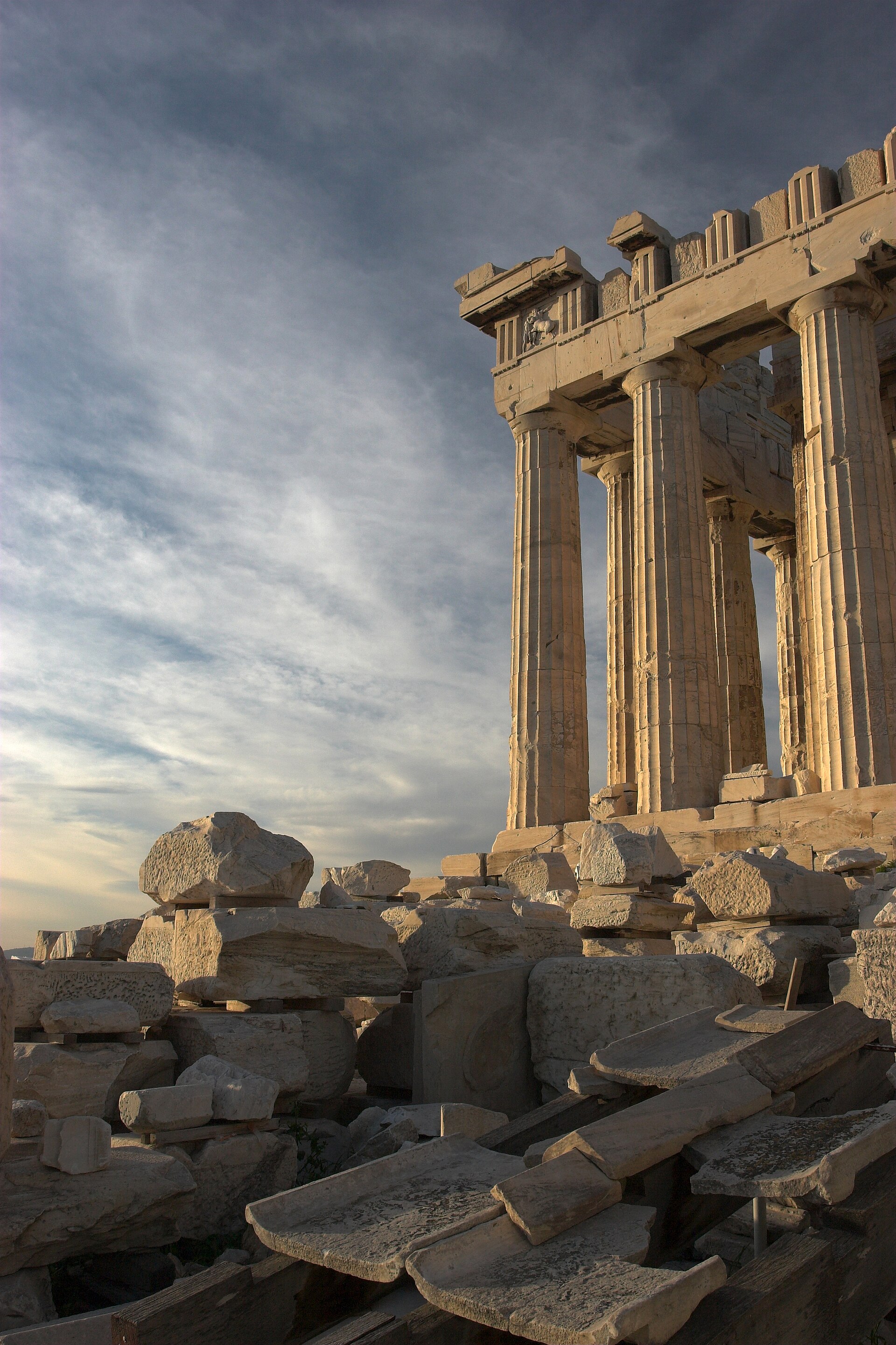
ACROPOLIS OF ATHENS · OVERVIEW
The Acropolis of Athens is an ancient citadel located on a rocky outcrop above the city of Athens, Greece, and contains the remains of several ancient buildings of great architectural and historical significance, the most famous being the Parthenon. The word Acropolis is from Greek ἄκρον (akron) 'highest point, extremity' and πόλις (polis) 'city'. The term acropolis is generic and there are many other acropoleis in Greece. During ancient times the Acropolis of Athens was also more properly known as Cecropia (Κεκροπία), after the legendary serpent-man Cecrops, the supposed first Athenian king.
LOCATION ·
37.97167, 23.72611
World Heritage Record
Inscribed on the UNESCO World Heritage List in 1987. World Heritage criteria: (i)(ii)(iii)(iv)(vi). Official property area: 3.04 ha.
SOURCE · UNESCO World Heritage Centre
Outstanding Universal Value
The Acropolis of Athens is the most striking and complete ancient Greek monumental complex still existing in our times. It is situated on a hill of average height (156m) that rises in the basin of Athens. Its overall dimensions are approximately 170 by 350m.
SOURCE · UNESCO World Heritage Centre
Integrity & Condition
The Acropolis of Athens contains within its boundaries all the key attributes that convey the property’s Outstanding Universal Value, as an ensemble of unique splendor in excellent condition. The perfection of ancient building techniques ensured the resistance of the monuments to natural forces through time. Despite the unavoidable damage of time, they still display their beauty and convey their inestimable artistic and historic value, preserving all the features that directly and tangibly associate them with the events and ideas of Democracy and Philosophy.
SOURCE · UNESCO World Heritage Centre
Authenticity
The authenticity of the Acropolis hill, crowned with the masterpieces of Greek Classical art and architecture, is well preserved. In order to maintain the authenticity and structural integrity of the monuments, an integrated intervention begun in 1975 and continues today.
SOURCE · UNESCO World Heritage Centre
Protection & Management
The Acropolis has been operating as an archaeological site since 1833, shortly after the establishment of the modern Greek State. Nowadays, the property is strongly protected under the provisions of Law No 3028/2002 on the “Protection of Antiquities and Cultural Heritage in general”. Moreover, the Acropolis and its surroundings, which constitute monuments per se , are protected by legislative decrees (Ministerial Decrees F01/12970/503/25.2.82 concerning the designation of its buffer zone; and F43/7027/425/29.1.2004 concerning the designation of the peripheral zone of the city of Athens and imposing obligatory control before issuing any building or development permit within its boundaries).
SOURCE · UNESCO World Heritage Centre
The Acropolis Restoration Project
[ edit ] The Acropolis of Athens as seen from the Pnyx in October 2025 with the scaffolding on the west façade of the Parthenon removed after 15 years. The Acropolis Restoration Project began in 1975 to reverse the decay of centuries of attrition, pollution, destruction from military actions, and misguided past restorations. The project included the collection and identification of all stone fragments, even small ones, from the Acropolis and its slopes, and the attempt was made to restore as much as possible using reassembled original material ( anastylosis ), with new marble from Mount Pentelicus used sparingly. All restoration was made using titanium dowels and is designed to be completely reversible, in case future experts decide to change things. A combination of cutting-edge modern technology and extensive research and reinvention of ancient techniques were used. The Parthenon colonnades, largely destroyed by Venetian bombardment during the 17th century, were restored, with many wrongly assembled columns now properly placed. The roof and floor of the Propylaea were partly restored, with sections of the roof made of new marble and decorated with blue and gold inserts, as in the original. Restoration of the Temple of Athena Nike was completed in 2010. A total of 2,675 tons of architectural members were restored, with 686 stones reassembled from fragments of the originals, 905 patched with new marble, and 186 parts made entirely of new marble. A total of 530 cubic meters of new Pentelic marble were used. In 2021, the addition of new reinforced concrete paths to the site to improve accessibility caused controversy among archaeologists.