CHRIST THE REDEEMER · OVERVIEW
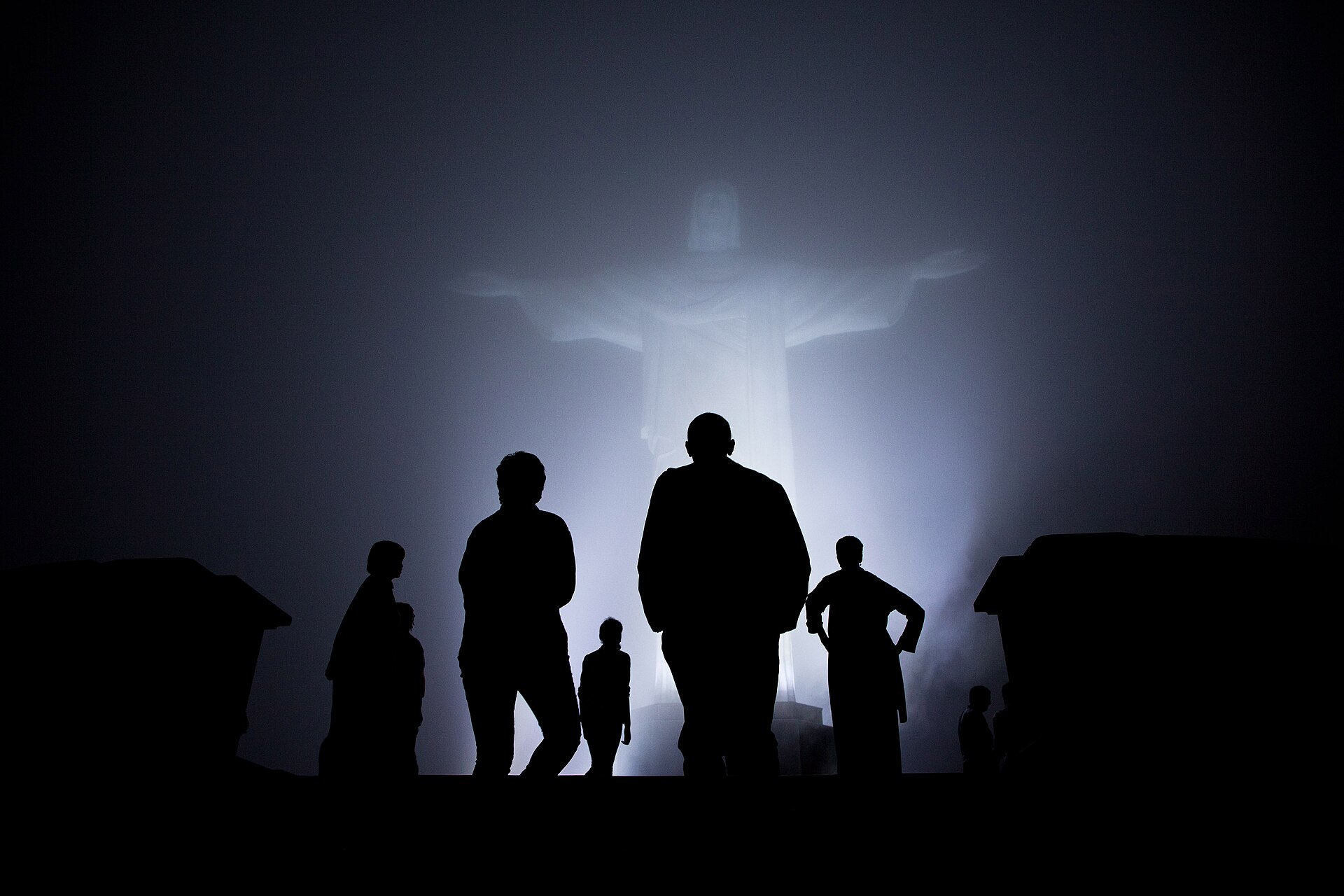
Christ the Redeemer is an Art Deco statue of Jesus in Rio de Janeiro, Brazil, created by French-Polish sculptor Paul Landowski and built by Brazilian engineer Heitor da Silva Costa, in collaboration with French engineer Albert Caquot and Romanian sculptor Gheorghe Leonida who sculpted the face. Constructed between 1922 and 1931, the statue is 30 metres (98 ft) high, excluding its 8-metre (26 ft) pedestal, and faces east. The arms stretch 28 metres (92 ft) wide. It is made of reinforced concrete and soapstone. Christ the Redeemer differs considerably from its original design, as the initial plan was a large Christ with a globe in one hand and a cross in the other. Although the project organizers originally accepted the design, it later changed to the statue of today, with the arms spread out wide.
LOCATION ·
-22.95194, -43.21056
History
[ edit ] A view of Corcovado before the construction, between 1880 and 1900 The peak of Corcovado with the statue under construction, c. 1930−1931 Vincentian priest Pedro Maria Boss first suggested placing a Christian monument on Mount Corcovado in the mid-1850s to honor Princess Isabel , regent of Brazil and the daughter of Emperor Pedro II , but the project was not approved. In 1889, the country became a republic, and owing to the separation of church and state , the proposed statue was dismissed. The Catholic Circle of Rio made a second proposal for a landmark statue on the mountain in 1920. The group organized an event called Semana do Monumento ("Monument Week") to attract donations and collect signatures to support the building of the statue. The organization was motivated by what they perceived as "Godlessness" in the society. The donations came mostly from Brazilian Catholics . The designs considered for the "Statue of the Christ" included a representation of the Christian cross , a statue of Jesus with a globe in his hands, and a pedestal symbolizing the world. Eventually, the statue of Christ the Redeemer with open arms, a symbol of peace, was chosen. Local engineer Heitor da Silva Costa and artist Carlos Oswald designed the statue. French sculptor Paul Landowski created the work. In 1922, Landowski commissioned fellow Parisian Romanian sculptor Gheorghe Leonida , who studied sculpture at the Fine Arts Conservatory in Bucharest and in Italy. Christ the Redeemer in 1931 A group of engineers and technicians studied Landowski's submissions, and they felt building the structure out of reinforced concrete (designed by Albert Caquot ) instead of steel was more suitable for the cross -shaped statue. The concrete making up the base was supplied from Limhamn , Sweden. The outer layers are soapstone , chosen for its enduring qualities and ease of use. Construction took nine years, from 1922 to 1931, and cost the equivalent of US$250,000 (equivalent to $4,500,000 in 2025) and the monument opened on October 12, 1931. During the opening ceremony, the statue was to be lit by a battery of floodlights turned on remotely by Italian shortwave radio inventor Guglielmo Ma
Restoration
[ edit ] A panoramic view of the statue at the top of Corcovado Mountain with Sugarloaf Mountain (centre) and Guanabara Bay in the background Christ the Redeemer aerial view with Tijuca Forest Christ the Redeemer atop Corcovado with Sugarloaf Mountain in background In 1990, several organizations, including the Archdiocese of Rio de Janeiro , media company Grupo Globo , oil company Shell do Brasil, environmental regulator IBAMA , National Institute of Historic and Artistic Heritage , and the city government of Rio de Janeiro entered into an agreement to conduct restoration work. More work on the statue and its environs was conducted in 2003 and early 2010. In 2003, a set of escalators , walkways , and elevators were installed to facilitate access to the platform surrounding the statue. The four-month restoration in 2010 focused on the statue itself. The statue's internal structure was renovated and its soapstone mosaic covering was restored by removing a crust of fungi and other microorganisms and repairing small cracks. The lightning rods located in the statue's head and arms were also repaired, and new lighting fixtures were installed at the foot of the statue. The restoration involved one hundred people and used more than 60,000 pieces of stone taken from the same quarry as the original statue. During the unveiling of the restored statue, it was illuminated with green-and-yellow lighting in support of the Brazil national football team playing in the 2010 FIFA World Cup . Maintenance work needs to be conducted periodically because of the strong winds and erosion to which the statue is exposed, as well as lightning strikes. The original pale stone is no longer available in sufficient quantity, and replacement stones are increasingly darker in hue. Approximate heights of various notable statues: Statue of Unity 240 m (790 ft) (incl. 58 m (190 ft) base) Spring Temple Buddha 153 m (502 ft) (incl. 25 m (82 ft) pedestal and 20 m (66 ft) throne) Statue of Liberty ( Liberty Enlightening the World ) 93 m (305 ft) (incl. 47 m (154 ft) pedestal) The Motherland Calls 87 m (285 ft) (incl. 2 m (6 ft 7 in) pedestal) Christ the Redeemer 38 m (125 ft) (incl. 8 m (26 ft) pedesta
Similar structures
[ edit ] Angola Cristo Rei in Lubango ( 14 m, 46 ft ) Argentina/Chile Christ the Redeemer of the Andes Bolivia Cristo de la Concordia in Cochabamba ( 34 m, 112 ft ) Brazil Cristo Luz in Balneário Camboriú , Santa Catarina Christ the Protector in Encantado, Rio Grande do Sul ( 43 m, 141 ft ) Statue in Jataí , southern Goiás Christ in the Mount in Pitangui , Minas Gerais [ citation needed ] Christ the Redeemer in Rio Verde, Goiás Colombia Cristo Rey in Cali ( 26 m, 85 ft ) Cuba Christ of Havana in Havana , inspired by Christ the Redeemer ( 20 m, 66 ft ) Dominican Republic Cristo Redentor , Puerto Plata East Timor Cristo Rei of Dili in Dili ( 27 m, 89 ft ) Honduras Christ at El Picacho in Tegucigalpa India Imitation statue of Christ the Redeemer at Nellore , state of Andhra Pradesh Imitation at St. Joseph Shrine, Vizhinjam, near Trivandrum , Kerala, India Imitation at Ecopark, Kolkata , India Indonesia Christ Blessing in Manado , North Sulawesi ( 30 m, 98 ft ) Patung Yesus Kristus in Mansinam Island , West Papua, Indonesia ( 30 m, 98 ft ) Italy Cristo Redentore (Christ the Redeemer) of Maratea ( 21 m, 69 ft ) Philippines Risen Christ statue on top of Tombol Hill in Rosario, Batangas Lebanon Christ the King , past Nahr al-Kalb on the coast Malaysia Christ the Redeemer of Malacca , on the Portuguese Settlement Square in Melaka ( 20 ft, 6.1 m ) Malta Tas-Salvatur in Gozo ( 12 m, 39 ft ) Mexico Cristo Rey on the Cerro del Cubilete in Guanajuato , inspired by Rio's Christ the Redeemer ( 23 m, 75 ft ) Cristo del Sagrado Corazón , Villas San Pedro, Carretera Libre Tijuana Ensenada Km 37.5, Playa de Rosarito , Baja California (75 foot, 40 ton, steel and fiberglass, colored) Cristo Rey in Tenancingo, México ( 30 m, 98 ft ) Cristo Rey , at Iglesia de San Martín de Porres near Colonia Los Álamos, Tijuana , Baja California ( 23 m, 75 ft 30 cm) Cristo de las Noas in Torreón ( 22 m, 72 ft ) Nigeria Jesus de Greatest in Imo , Africa's tallest statue of Jesus and fifth tallest statue on the continent ( 8.53 m, 28.0 ft ) Peru Cristo Blanco in Cusco Cristo del Pacífico in Lima , erected in 2011 ( 37 m, 121 ft ) Cristo Redentor in Barranca Province , Lima Region, Peru Statue in Yunga
Further reading
[ edit ] Blanes, Ruy Llera (2014). "Review: Giumbelli, Emerson (2014), Símbolos Religiosos em Controvérsia. São Paulo: Terceiro Nome" . Vibrant: Virtual Brazilian Anthropology (in Portuguese). 11 (2): 470– 472. doi : 10.1590/S1809-43412014000200016 . ISSN 1809-4341 . Giumbelli, Emerson (2008). "A modernidade do Cristo Redentor" . Dados (in Portuguese). 51 (1): 75– 105. doi : 10.1590/S0011-52582008000100003 . ISSN 0011-5258 . Giumbelli, Emerson & Bosisio, Izabella (2010). "A Política de um Monumento: as Muitas Imagens do Cristo Redentor" . Debates do NER (in Portuguese). 2 (18): 173– 192. doi : 10.22456/1982-8136.17638 . hdl : 10183/187720 . ISSN 1982-8136 . Giumbelli, Emerson (2013). "O Cristo Pichado" . Ponto Urbe. Revista do Núcleo de Antropologia Urbana da USP (in Portuguese) (12). doi : 10.4000/pontourbe.586 . ISSN 1981-3341 . Ranquetat-Júnior, Cesar Alberto (2012). Laicidade à brasileira: um estudo sobre a controvérsia em torno da presença de símbolos religiosos em espaços públicos (Doutorado em Antropologia Social) (in Portuguese). UFRGS . 310 pp. hdl : 10183/54437 . Ranquetat-Júnior, Cesar Alberto (2015). "Giumbelli, Emerson. Símbolos Religiosos em Controvérsia. São Paulo: Terceiro Nome, 2014" . Debates do NER (in Portuguese). 1 (27): 429– 437. doi : 10.22456/1982-8136.56490 . ISSN 1982-8136 .