Restoration
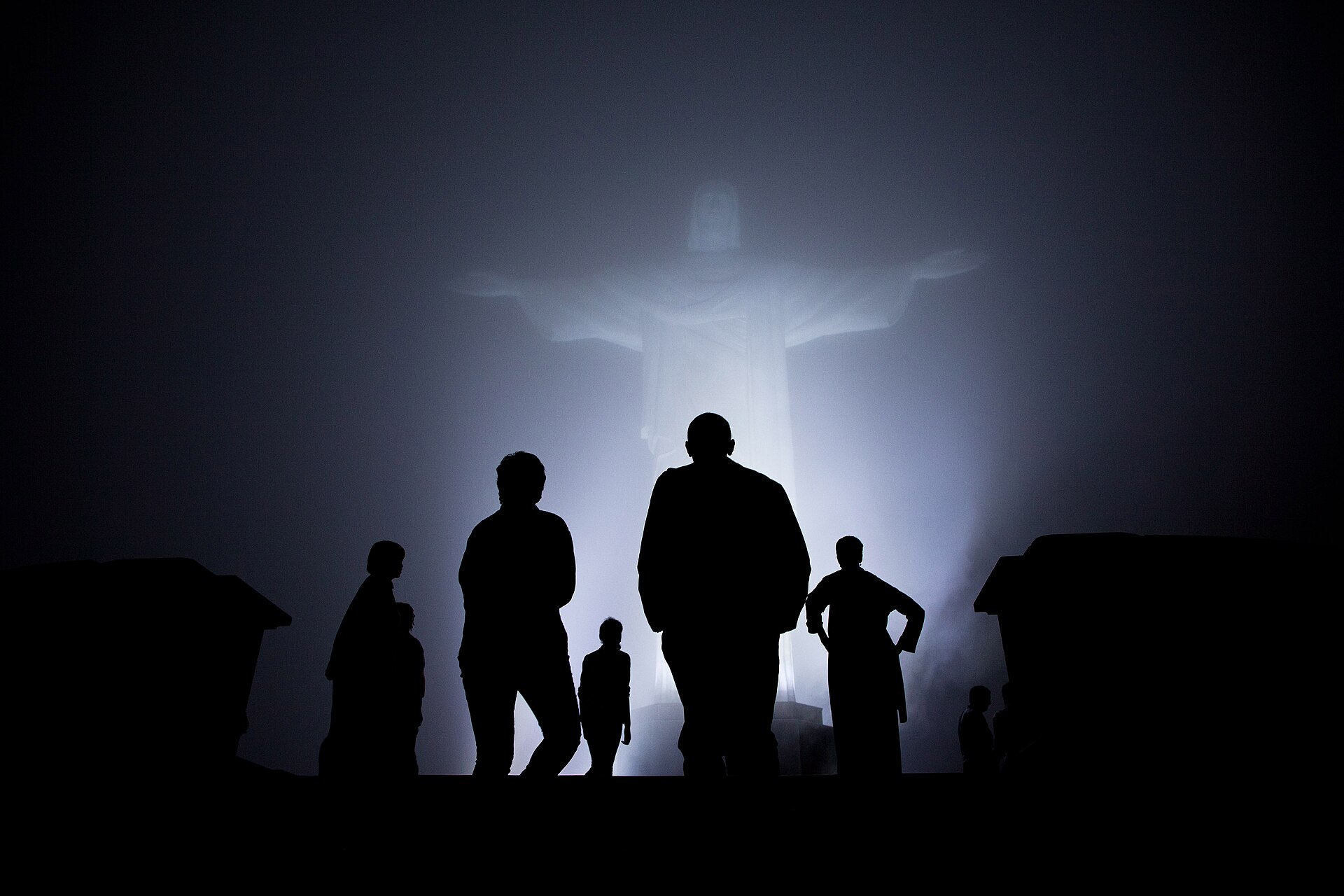
[ edit ] A panoramic view of the statue at the top of Corcovado Mountain with Sugarloaf Mountain (centre) and Guanabara Bay in the background Christ the Redeemer aerial view with Tijuca Forest Christ the Redeemer atop Corcovado with Sugarloaf Mountain in background In 1990, several organizations, including the Archdiocese of Rio de Janeiro , media company Grupo Globo , oil company Shell do Brasil, environmental regulator IBAMA , National Institute of Historic and Artistic Heritage , and the city government of Rio de Janeiro entered into an agreement to conduct restoration work. More work on the statue and its environs was conducted in 2003 and early 2010. In 2003, a set of escalators , walkways , and elevators were installed to facilitate access to the platform surrounding the statue. The four-month restoration in 2010 focused on the statue itself. The statue's internal structure was renovated and its soapstone mosaic covering was restored by removing a crust of fungi and other microorganisms and repairing small cracks. The lightning rods located in the statue's head and arms were also repaired, and new lighting fixtures were installed at the foot of the statue. The restoration involved one hundred people and used more than 60,000 pieces of stone taken from the same quarry as the original statue. During the unveiling of the restored statue, it was illuminated with green-and-yellow lighting in support of the Brazil national football team playing in the 2010 FIFA World Cup . Maintenance work needs to be conducted periodically because of the strong winds and erosion to which the statue is exposed, as well as lightning strikes. The original pale stone is no longer available in sufficient quantity, and replacement stones are increasingly darker in hue. Approximate heights of various notable statues: Statue of Unity 240 m (790 ft) (incl. 58 m (190 ft) base) Spring Temple Buddha 153 m (502 ft) (incl. 25 m (82 ft) pedestal and 20 m (66 ft) throne) Statue of Liberty ( Liberty Enlightening the World ) 93 m (305 ft) (incl. 47 m (154 ft) pedestal) The Motherland Calls 87 m (285 ft) (incl. 2 m (6 ft 7 in) pedestal) Christ the Redeemer 38 m (125 ft) (incl. 8 m (26 ft) pedesta


