World Heritage Record
Inscribed on the UNESCO World Heritage List in 1979. World Heritage criteria: (vii)(viii)(ix)(x). Official property area: 493,270 ha.
SOURCE · UNESCO World Heritage Centre
Outstanding Universal Value
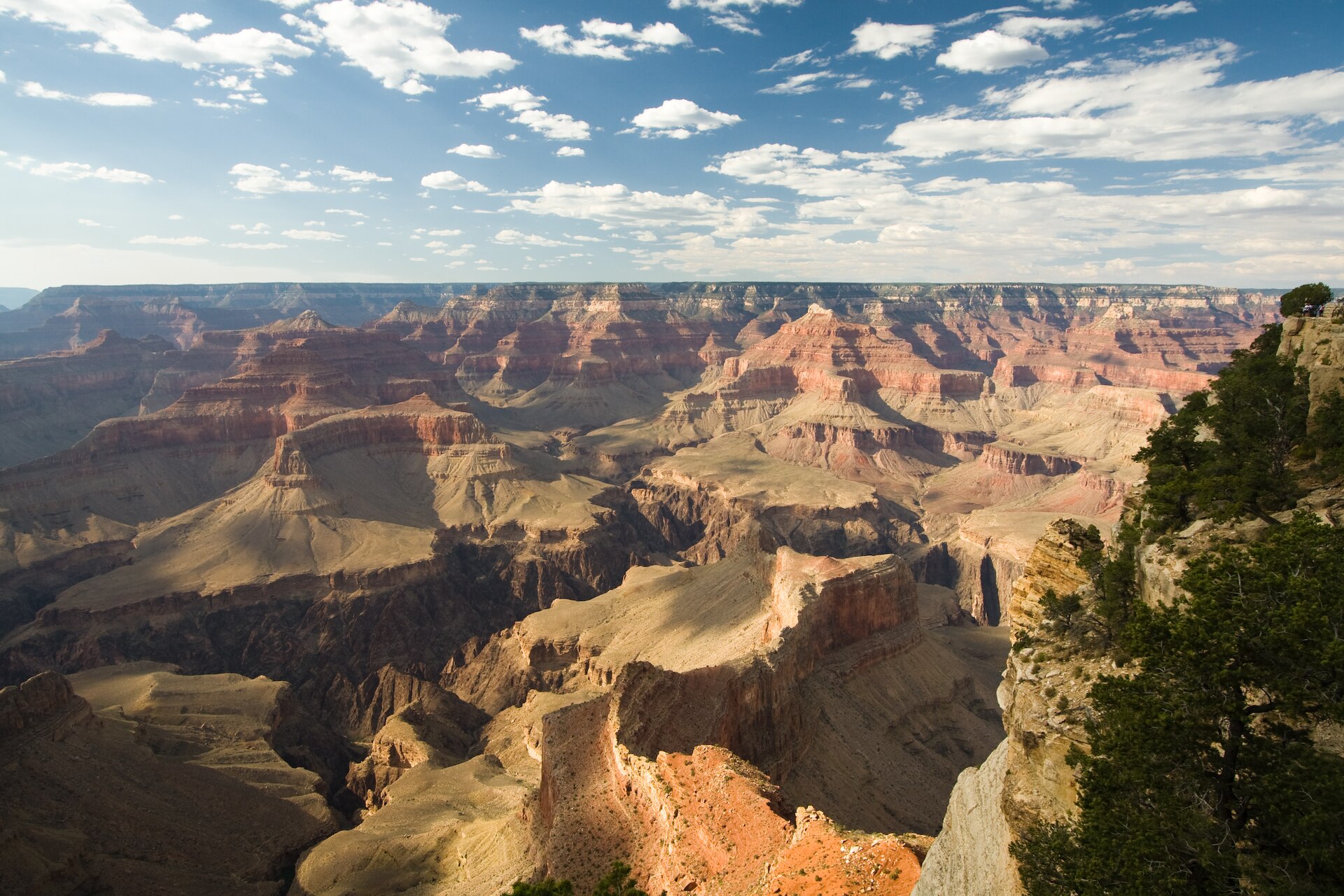
The Grand Canyon is among the earth’s greatest on-going geological spectacles. Its vastness is stunning, and the evidence it reveals about the earth’s history is invaluable. The 1.5-kilometer (0.9 mile) deep gorge ranges in width from 500 m to 30 km (0.3 mile to 18.6 miles).
SOURCE · UNESCO World Heritage Centre
Integrity & Condition
At nearly 500,000 hectares, and with 94% of the park managed for wilderness values, the property is large enough to ensure protection of all the geological and geomorphological values for which it was inscribed. Scenic values are also well protected, though these can be significantly impacted by air pollution originating from outside park boundaries. Natural quiet, an important component of the visitor experience, is impacted by aircraft overflights and other human caused sounds in some parts of the property.
SOURCE · UNESCO World Heritage Centre
Protection & Management
Designated by the U.S. Congress in 1919 as a national park, Grand Canyon is managed under the authority of the Organic Act of August 25, 1916 which established the United States National Park Service , and which directs park resources to managed “in such manner and by such means as will leave them unimpaired for the enjoyment of future generations.” In addition, the park has specific enabling legislation which provides broad congressional direction regarding the primary purposes of the park. Numerous other federal laws bring additional layers of protection to the park.
SOURCE · UNESCO World Heritage Centre
Federal protection: National monument and park
[ edit ] Railway Station and El Tovar Hotel , Facing WNW, Grand Canyon Village . 1994 photo, HAER Fred Harvey postcard, The Towering Cliffs above Hermit Camp U.S. President Theodore Roosevelt visited the Grand Canyon in 1903. An avid outdoorsman and staunch conservationist, Roosevelt established the Grand Canyon Game Preserve on November 28, 1906. Livestock grazing was reduced, but predators such as mountain lions, eagles, and wolves were eradicated. Roosevelt along with other members of his conservation group, the Boone and Crockett Club helped form the National Parks Association , which in turn lobbied for the Antiquities Act of 1906 which gave Roosevelt the power to create national monuments. Once the act was passed, Roosevelt immediately added adjacent national forest lands and redesignated the preserve a U.S. National Monument on January 11, 1908. Opponents such as land and mining claim holders blocked efforts to reclassify the monument as a U.S. National Park for 11 years. Grand Canyon National Park was finally established as the 17th U.S. National Park by an Act of Congress signed into law by President Woodrow Wilson on February 26, 1919. The federal government administrators who manage park resources face many challenges. These include issues related to the recent reintroduction into the wild of the highly endangered California condor , air tour overflight noise levels, water rights and management disputes, and forest fire management. The canyon's ecosystem was permanently changed after the construction of the Glen Canyon Dam in 1963. Average flood levels dropped from 85,000 to 8,000 cubic ft/sec. In the absence of natural flooding, sandbars and beaches eroded and invasive species began to displace native species. Federal officials started releasing floods in the Grand Canyon in hopes of restoring its ecosystem beginning with 1996, 2004, and 2008. In 2018, the Department of Interior started experimenting with "adaptive management" of the Glen Canyon Dam, using a High-Flow Experiment (HFE) water release to shift volumes of sand and monitoring effects such as the dispersal of invasive tamarisk seeds. In 2022, extreme drought dropped Lake Powell's water lev
Tourism
[ edit ] Grand Canyon National Park is one of the world's premier natural attractions, attracting about five million visitors per year. According to a survey conducted of visitors to the canyon between September 2003 through August 2004, 83% were from the United States: California (12%), Arizona (9%), Texas (5%), Florida (3%) and New York (4%) represented the top domestic visitors. Seventeen percent of visitors were from outside the United States; the most prominently represented nations were the United Kingdom (3%), Canada (4%), Japan (2%), Germany (2%) and the Netherlands (1%). The South Rim is open all year, weather permitting. The North Rim is generally open mid-May to mid-October.