Names
[ edit ] Huayi tu , an 1136 map of China with the Great Wall depicted on the northern edge of the country The collection of fortifications known as the Great Wall of China has historically had a number of different names in both Chinese and English. In Chinese histories , the term "Long Wall(s)" ( t 長城, s 长城, Chángchéng ) appears in Sima Qian 's Records of the Grand Historian , where it referred both to the separate great walls built between and north of the Warring States and to the more unified construction of the First Emperor . The Chinese character 城 , meaning city or fortress, is a phono-semantic compound of the "earth" radical 土 and phonetic 成 , whose Old Chinese pronunciation has been reconstructed as * deŋ . It originally referred to the rampart which surrounded traditional Chinese cities and was used by extension for these walls around their respective states ; today, however, it is more commonly used to mean "city". The longer Chinese name "Ten-Thousand Mile Long Wall" ( t 萬里長城, s 万里长城, Wànlǐ Chángchéng ) came from Sima Qian's description of it in the Records , though he did not name the walls themselves as such. The AD 493 Book of Song quotes the frontier general Tan Daoji referring to "the long wall of 10,000 miles", closer to the modern name, but the name rarely features in pre-modern times otherwise. The traditional Chinese mile ( 里 , lǐ ) was an often irregular distance that was intended to show the length of a standard village and varied with terrain but was usually standardized at distances around a third of an English mile (540 m). However, this use of "ten-thousand" ( wàn ) is figurative in a similar manner to the Greek and English myriad and simply means "innumerable" or "immeasurable". Because of the wall's association with the First Emperor's supposed tyranny , the Chinese dynasties after Qin usually avoided referring to their own additions to the wall by the name "Long Wall". Instead, various terms were used in medieval records, including "frontier(s)" ( 塞 , Sài ), "rampart(s)" ( 垣 , Yuán ), "barrier(s)" ( 障 , Zhàng ), "the outer fortresses" ( 外 堡 , Wàibǎo ), and "the border wall(s)" ( t 邊 牆 , s 边 墙 , Biānqiáng ). Poetic and informal name
Early walls
[ edit ] The Great Wall of the Qin stretches from Lintao to Liaodong. Further information: Great Wall of Qi The Chinese were already familiar with the techniques of wall-building by the time of the Spring and Autumn period between the 8th and 5th centuries BC. During this time and the subsequent Warring States period , the states of Zheng , Chu , Qin , Wei , Zhao , Qi , Lu , Han , Yan , Zhongshan and Zhou all constructed extensive fortifications to defend their own borders. Built to withstand the attack of small arms such as swords and spears, these walls were made mostly of stone or by stamping earth and gravel between board frames. The Great Wall of the Han is the longest of all walls, from Mamitu, near Yumenguan , to Liaodong. The state of Qin emerged victorious in 221 BC; its ruler, now the First Emperor of a unified China, intended to centralize rule and prevent the resurgence of feudal lords; in doing so, he ordered the destruction of the sections of the walls that divided his empire among the former states. To position the empire against the Xiongnu people from the north, however, he ordered the building of new walls to connect the remaining fortifications along the northern frontier. "Build and move on" was a central guiding principle in constructing the wall, implying that the Chinese were not erecting a permanently fixed border. Transporting the large quantity of materials required for construction was difficult, so builders always tried to use local resources; stone was used in montane areas, while rammed earth was used while building in the plains. There are no surviving historical records indicating the exact length and course of the Qin walls, as most of the ancient walls have eroded away over the centuries, and very few sections remain today. Later, the Han , the Northern dynasties and the Sui all repaired, rebuilt, or expanded sections of the Great Wall at great cost to defend themselves against northern invaders. The Tang and Song dynasties did not undertake any significant effort in the region. Dynasties founded by non-Han ethnic groups also built border walls: the Xianbei -ruled Northern Wei , the Khitan -ruled Liao , Jurchen -led Jin and the
Ming and Qing eras
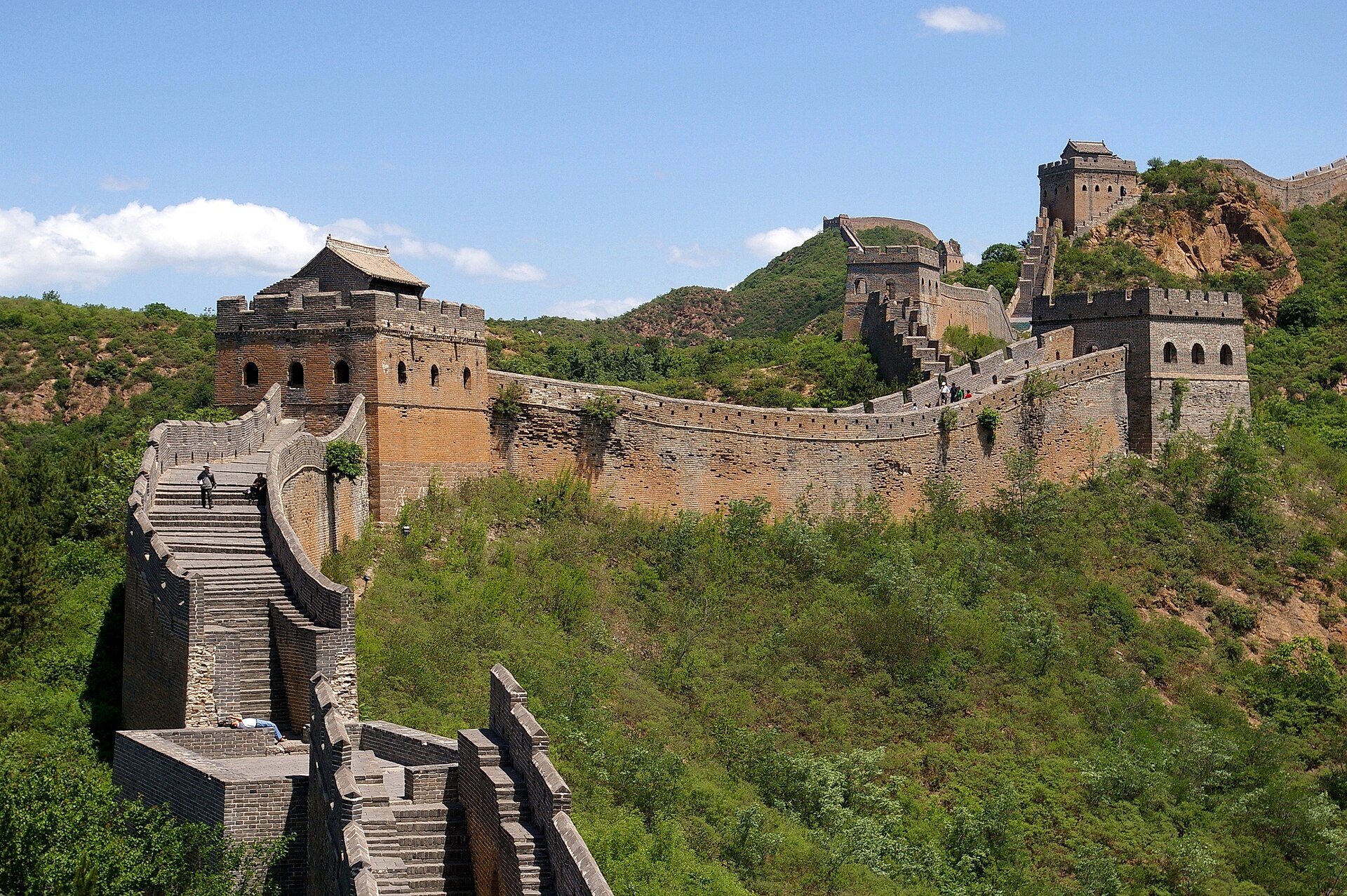
[ edit ] Main article: Ming Great Wall The Ming dynasty made substantial contributions to the Great Wall, following their defeat to the Oirats in the Battle of Tumu . This defeat had come in the context of protracted conflict with Mongol tribes; a new strategy for defense was thus realized by constructing walls along the northern border of China. Acknowledging the Mongol control established in the Ordos Desert , the wall followed the desert's southern edge, instead of incorporating the bend of the Yellow River . Unlike the earlier fortifications, the Ming construction was stronger and more elaborate, due to the use of bricks and stone instead of rammed earth. Up to 25,000 watchtowers are estimated to have been constructed on the wall. As Mongol raids continued periodically over the years, the Ming devoted considerable resources to repair and reinforce the walls; sections near the Ming capital of Beijing were especially strong. Under general Qi Jiguang 's supervision, 1,200 watchtowers from Shanhaiguan Pass to Changping were constructed between 1567 and 1570, and sections of the ram-earth wall were faced with bricks. During the mid–15th century, the Ming also built a so-called "Liaodong Wall". It enclosed the agricultural heartland of the Liaodong province, protecting it against potential incursions by Jurchen-Mongol Oriyanghan from the northwest and the Jianzhou Jurchens from the north. While stones and tiles were sometimes used here, it was otherwise simply an earth dike with moats on both sides. Towards the end of the Ming, the Great Wall helped defend the empire against the Manchu invasions that began around 1600. Even after the loss of all of Liaodong , the Ming army held the heavily fortified Shanhai Pass , preventing the Manchus from conquering the Chinese heartland. The Manchus were finally able to cross the Great Wall in 1644, after Beijing had already fallen to Li Zicheng 's short-lived Shun dynasty . Before this time, the Manchus had crossed the Great Wall multiple times to raid, but this time it was for conquest. The gates at Shanhai Pass were opened on May 25 by the commanding Ming general, Wu Sangui , who formed an alliance with the Manchus, hoping
Foreign accounts
[ edit ] Part of the Great Wall of China (April 1853, X, p. 41) The Great Wall in 1907 None of the Europeans who visited China or Mongolia in the 13th and 14th centuries, such as Giovanni da Pian del Carpine , William of Rubruck , Marco Polo , Odoric of Pordenone and Giovanni de' Marignolli , mentioned the Great Wall. The North African traveler Ibn Battuta , who also visited China during the Yuan dynasty c. 1346 , had heard about China's Great Wall, possibly before he had arrived in China. He wrote that the wall is "sixty days' travel" from Zeitun (modern Quanzhou ) in his travelogue Gift to Those Who Contemplate the Wonders of Cities and the Marvels of Travelling . He associated it with the legend of the wall mentioned in the Qur'an , which Dhul-Qarnayn (commonly associated with Alexander the Great ) was said to have erected to protect people near the land of the rising sun from the savages of Gog and Magog . However, Ibn Battuta could find no one who had either seen it or knew of anyone who had seen it, suggesting that although there were remnants of the wall at that time, they were not significant. Soon after the Portuguese reached Ming China by ship in the early 16th century, accounts of the Great Wall began circulating in Europe, although no European was able to see it for another 100 years. Possibly one of the earliest European descriptions of the wall and of its significance for the defense of the country against the " Tartars " (i.e. Mongols) may be the one contained in João de Barros 's 1563 Asia . Other early accounts in Western sources include those of Gaspar da Cruz , Bento de Goes , Matteo Ricci , and Bishop Juan González de Mendoza , the latter in 1585 describing it as a "superbious and mightie work" of architecture, though he had not seen it. In 1559, in his work "A Treatise of China and the Adjoyning Regions", Gaspar da Cruz offers an early discussion of the Great Wall. Perhaps the first recorded instance of a European actually entering China via the Great Wall came in 1605, when the Portuguese Jesuit brother Bento de Góis reached the northwestern Jiayu Pass from India. Early European accounts were mostly modest and empirical, closely mirroring c