Early walls
[ edit ] The Great Wall of the Qin stretches from Lintao to Liaodong. Further information: Great Wall of Qi The Chinese were already familiar with the techniques of wall-building by the time of the Spring and Autumn period between the 8th and 5th centuries BC. During this time and the subsequent Warring States period , the states of Zheng , Chu , Qin , Wei , Zhao , Qi , Lu , Han , Yan , Zhongshan and Zhou all constructed extensive fortifications to defend their own borders. Built to withstand the attack of small arms such as swords and spears, these walls were made mostly of stone or by stamping earth and gravel between board frames. The Great Wall of the Han is the longest of all walls, from Mamitu, near Yumenguan , to Liaodong. The state of Qin emerged victorious in 221 BC; its ruler, now the First Emperor of a unified China, intended to centralize rule and prevent the resurgence of feudal lords; in doing so, he ordered the destruction of the sections of the walls that divided his empire among the former states. To position the empire against the Xiongnu people from the north, however, he ordered the building of new walls to connect the remaining fortifications along the northern frontier. "Build and move on" was a central guiding principle in constructing the wall, implying that the Chinese were not erecting a permanently fixed border. Transporting the large quantity of materials required for construction was difficult, so builders always tried to use local resources; stone was used in montane areas, while rammed earth was used while building in the plains. There are no surviving historical records indicating the exact length and course of the Qin walls, as most of the ancient walls have eroded away over the centuries, and very few sections remain today. Later, the H
SOURCE · Wikipedia · CC BY-SA
Course
[ edit ] A formal definition of what constitutes a "Great Wall" has not been agreed upon, making the full course of the Great Wall difficult to describe in its entirety. The defensive lines contain multiple stretches of ramparts, trenches and ditches, as well as individual fortresses. In 2012, based on existing research and the results of a comprehensive mapping survey, the National Cultural Heritage Administration of China concluded that the remaining Great Wall associated sites include 10,051 wall sections, 1,764 ramparts or trenches, 29,510 individual buildings, and 2,211 fortifications or passes, with the walls and trenches spanning a total length of 21,196.18 km (13,170.70 mi). It was further concluded that the Ming Great Wall measures 8,850 km (5,500 mi). This consists of 6,259 km (3,889 mi) of wall sections, 359 km (223 mi) of trenches and 2,232 km (1,387 mi) of natural defensive barriers such as hills and rivers. In addition, Qin , Han and earlier Great Wall sites are 3,080 km (1,914 mi) long in total; Jin dynasty (1115–1234) border fortifications are 4,010 km (2,492 mi) in length; the remainder date back to Northern Wei , Northern Qi , Sui , Tang , the Five Dynasties , Song , Liao and Xixia . About half of the sites are located in Inner Mongolia and Hebei (31% and 19% respectively).
SOURCE · Wikipedia · CC BY-SA
Ming Great Wall
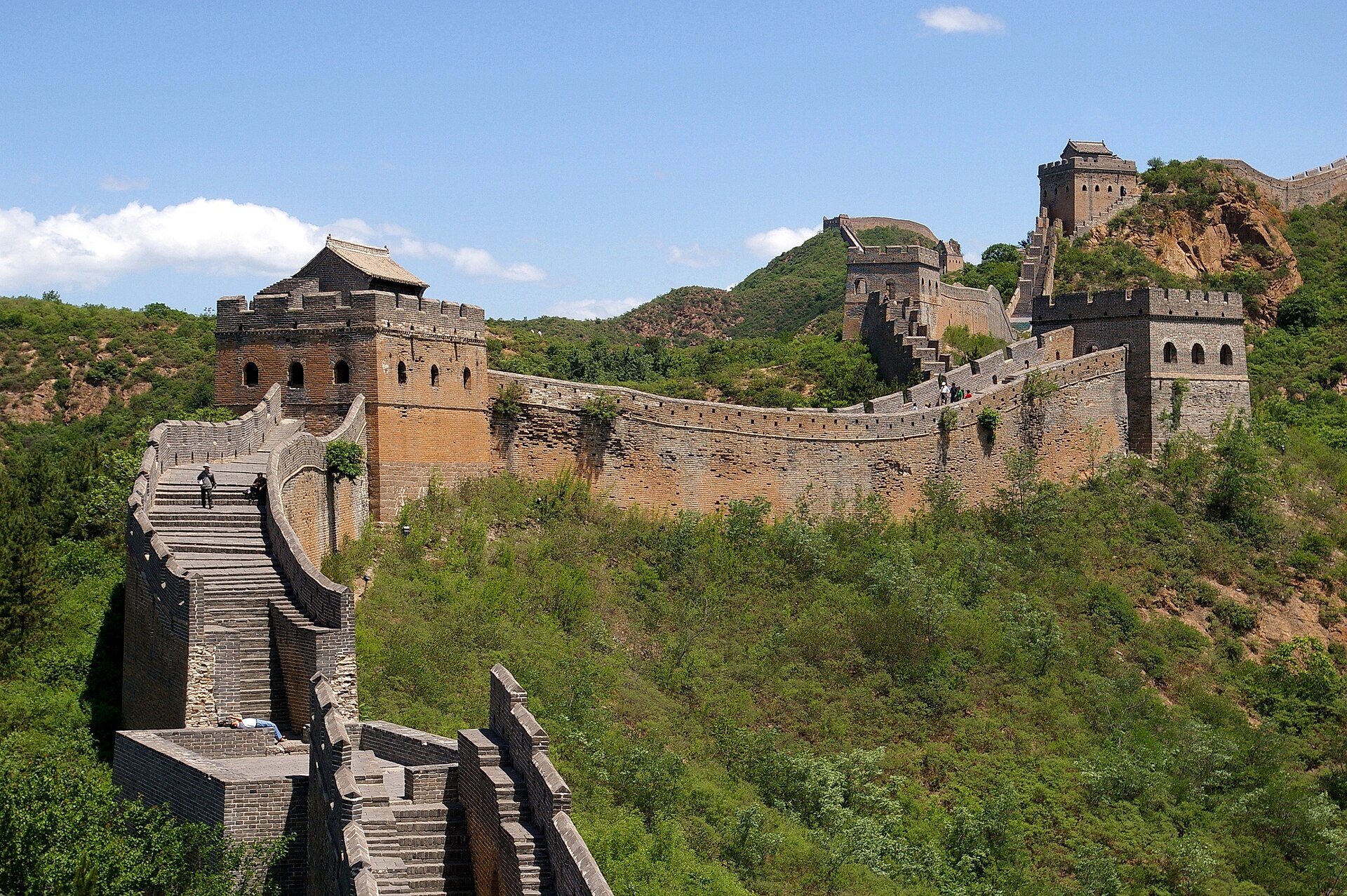
[ edit ] Jiayuguan , the westmost point of Ming Great Wall The Jiayu Pass , located in Gansu province, is the western terminus of the Ming Great Wall. From here, the wall travels discontinuously down the Hexi Corridor and into the deserts of Ningxia , where it enters the western edge of the Yellow River loop at Yinchuan . Here the first major walls erected during the Ming dynasty cut through the Ordos Desert to the eastern edge of the Yellow River loop. There, at Piantou Pass ( t 偏 頭 關 , s 偏 头 关 , Piāntóuguān ) in Xinzhou , Shanxi , the Great Wall splits in two with the "Outer Great Wall" ( t 外 長城 , s 外 长城 , Wài Chǎngchéng ) extending along the Inner Mongolia border with Shanxi into Hebei province, and the "Inner Great Wall" ( t 內 長城 , s 內 长城 , Nèi Chǎngchéng ) running southeast from Piantou Pass for some 400 km (250 mi), passing through important passes like the Pingxing Pass and Yanmen Pass before joining the Outer Great Wall at Sihaiye ( 四海 冶 , Sìhǎiyě ), in Beijing's Yanqing County . The sections of the Great Wall around Beijing were frequently renovated, and are regularly visited by tourists today. The Badaling Great Wall near Zhangjiakou is the most famous stretch of the wall, as it was the first section to be opened to the public in the People's Republic of China; foreign dignitaries would be shown this section on visits to the Great Wall. The Badaling Great Wall saw nearly 10 million visitors in 2018, and in 2019, a daily limit of 65,000 visitors was instated. South of Badaling is the Juyong Pass ; when it was used by the Chinese to protect their land, this section of the wall had many guards to defend the capital Beijing. Made of stone and bricks from the hills, this portion of the Great Wall is 7.8 m (25 ft 7 in) high and 5 m (16 ft 5 in) wide. Ming dynasty Gr
SOURCE · Wikipedia · CC BY-SA
Characteristics
[ edit ] 1793 technical drawings of the Great Wall produced during the Macartney Embassy to Qing dynasty. Before the use of bricks, the Great Wall was mainly built from rammed earth, stones, and wood. During the Ming, however, bricks were heavily used in many areas of the wall, as were materials such as tiles, lime , and stone. The size and weight of the bricks made them easier to work with than earth and stone, so construction quickened. Additionally, bricks could bear more weight and endure better than rammed earth. Stone can hold under its own weight better than brick, but is more difficult to use. Consequently, stones cut into rectangular shapes were used for the foundation, inner and outer brims , and gateways of the wall. Battlements line the uppermost portion of the vast majority of the wall, with defensive gaps a little over 30 cm (12 in) tall, and about 23 cm (9.1 in) wide. From the parapets, guards could survey the surrounding land. Sticky rice mortar , consisting of sticky rice soup mixed with slaked lime , was extensively used to hold bricks together; no human bones or body parts were ever incorporated into the mortar or any part of the wall, contrary to urban legend. Communication between the army units along the length of the Great Wall, including the ability to call reinforcements and warn garrisons of enemy movements, was of high importance. Signal towers were built upon hill tops or other high points along the wall for their visibility. Wooden gates could be used as a trap against those going through. Barracks, stables, and armories were built near the wall's inner surface.
SOURCE · Wikipedia · CC BY-SA