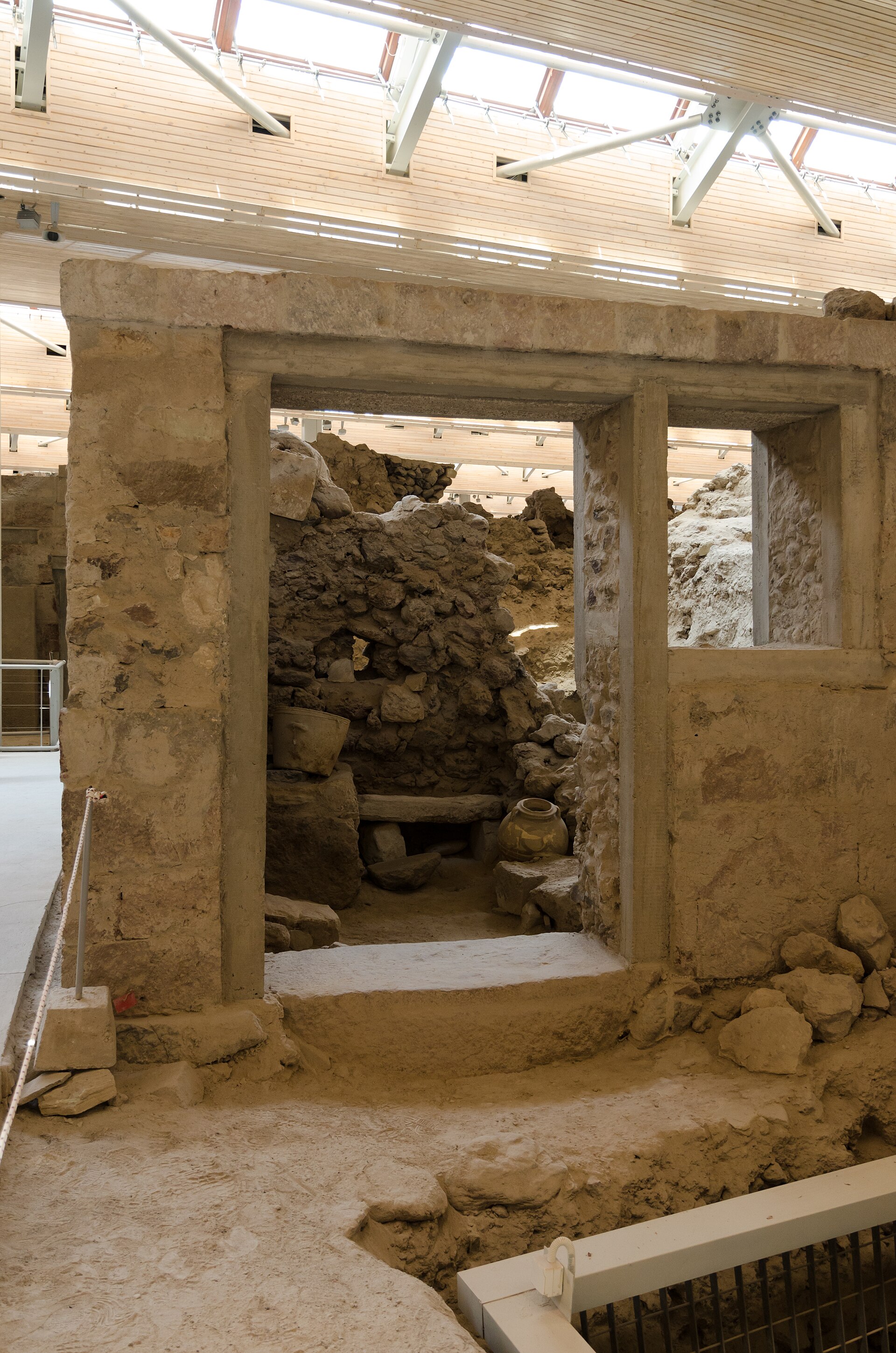
POMPEII · OVERVIEW
Pompeii was a city in what is now the municipality of Pompei, near Naples, in the Campania region of Italy. Along with Herculaneum, Stabiae, and many surrounding villas, it was buried under 4 to 6 m of volcanic ash and pumice in the eruption of Mount Vesuvius in 79 AD.
LOCATION ·
40.75000, 14.48611
Roman city development
[ edit ] Portico in front of the entrance of the Macellum Owing to its wealth and its Greek, Etruscan and Roman history, Pompeii is of great interest for the study of Ancient Roman architecture in terms of building methods and urban planning. However, it was a relatively small provincial city and, except for the Amphitheatre , it did not have large monuments on the scale of other Roman cities. It also missed the large building schemes of the early Empire and kept much of its urban architecture dating from as early as the 4th century BC. The evolution of Pompeii's private and public buildings is often unclear because of the lack of excavations beneath the levels of 79. It is, however, clear that by the time of the conquest by Sulla in 89 BC, the development of the street layout was largely complete, and most of the insulae were built.
SOURCE · Wikipedia · CC BY-SA
Public buildings
[ edit ] Location of public baths and sports buildings The Amphitheatre of Pompeii Under the Romans, Pompeii underwent a process of urban development which accelerated in the Augustan period from about 30 BC. New public buildings included the Amphitheatre with palaestra or gymnasium with a central natatorium ( cella natatoria ) or swimming pool, two theatres, the Eumachia Building and at least four public baths. The amphitheatre has been cited by scholars as a model of sophisticated design, particularly in the area of crowd control. Other service buildings were the Macellum ("meat market"); the Pistrinum (baker); the thermopolia (inns or snack-bars that served hot and cold dishes and drinks), and cauponae ("pubs" or "dives" with a seedy reputation as hangouts for thieves and prostitutes ). At least one building, the Lupanar , was dedicated to prostitution . A large hotel or hospitium (of 1,000 m 2 ) was found nearby at Murecine/Moregine, when the Naples-Salerno motorway was being built, and the Murecine Silver Treasure and the Tablets (providing a unique record of business transactions), as well as the Moregine bracelet , were discovered there. An aqueduct provided water to the public baths, to more than 25 street fountains, and to many private houses and businesses. The aqueduct was a branch of the great Serino Aqueduct built to serve the other large towns in the Bay of Naples region and the important naval base at Misenum . The castellum aquae is well preserved and includes many details of the distribution network and its controls.
SOURCE · Wikipedia · CC BY-SA
Shops and workshops
[ edit ] Bakery in Region VIII Thermopolium of Vetutius Placidus opening directly onto the Via dell'Abbondanza There were at least 31 bakeries in the town, each with wood-burning ovens, millstones and a sales counter. The Modestus bakery, or House of the Oven, was the largest in the city and Sotericus's bakery, also among the largest, preserves the room for kneading bread. Thermopolia were inns or snack-bars in which hot food and drinks were sold and in Pompeii there were nearly 100. The thermopolium of Vetutius Placidus overlooked the street directly, had a counter and several dolia , as well as a room behind the shop where customers could eat their meals: the lararium with frescoes of the Lares and Mercury and Dionysus and a triclinium decorated in the Third style . In the thermopolium of Asellina, with three sales counters and a lararium with depictions of Mercury and Bacchus , numerous furnishings have been found, both in bronze and terracotta, as well as 683 sesterces ; the external façade bears a representation of jugs and funnels and an electoral inscription referring to Asellina, probably the owner of the inn. Wool processing was well developed with 13 workshops that worked the raw material, seven that did the spinning, nine the dyeing, and 18 the washing: the Building of Eumachia, from the name of the priestess who built it, was the wool market, or the seat of the fullers guild; construction took place after 62 and was entirely in brickwork. Inside it has numerous niches in which statues were housed, mostly concerning the imperial family, a colonnade, and near the entrance, there was a jar in which urine was collected for use as a detergent for clothes. The fullonica of Stephanus, named after the owner or manager, was originally a house that was transformed int
SOURCE · Wikipedia · CC BY-SA
Lists of buildings
[ edit ] Public buildings Amphitheatre of Pompeii Eumachia building Macellum of Pompeii Suburban Baths Stabian Baths Temple of Apollo Temple of Isis Temple of Jupiter Theatre Area of Pompeii Town houses ( Domus ) House of the Centenary House of the Faun House of Julia Felix House of the Greek Epigrams House of Lucius Caecilius Iucundus House of Loreius Tiburtinus House of Menander House of the Prince of Naples House of Sallust House of the Silver Wedding House of the Small Fountain (Pompeii) House of the Surgeon House of the Tragic Poet House of the Vettii Exterior villas Villa of Diomedes Villa of the Mysteries Other The Garden of the Fugitives Lupanar
SOURCE · Wikipedia · CC BY-SA