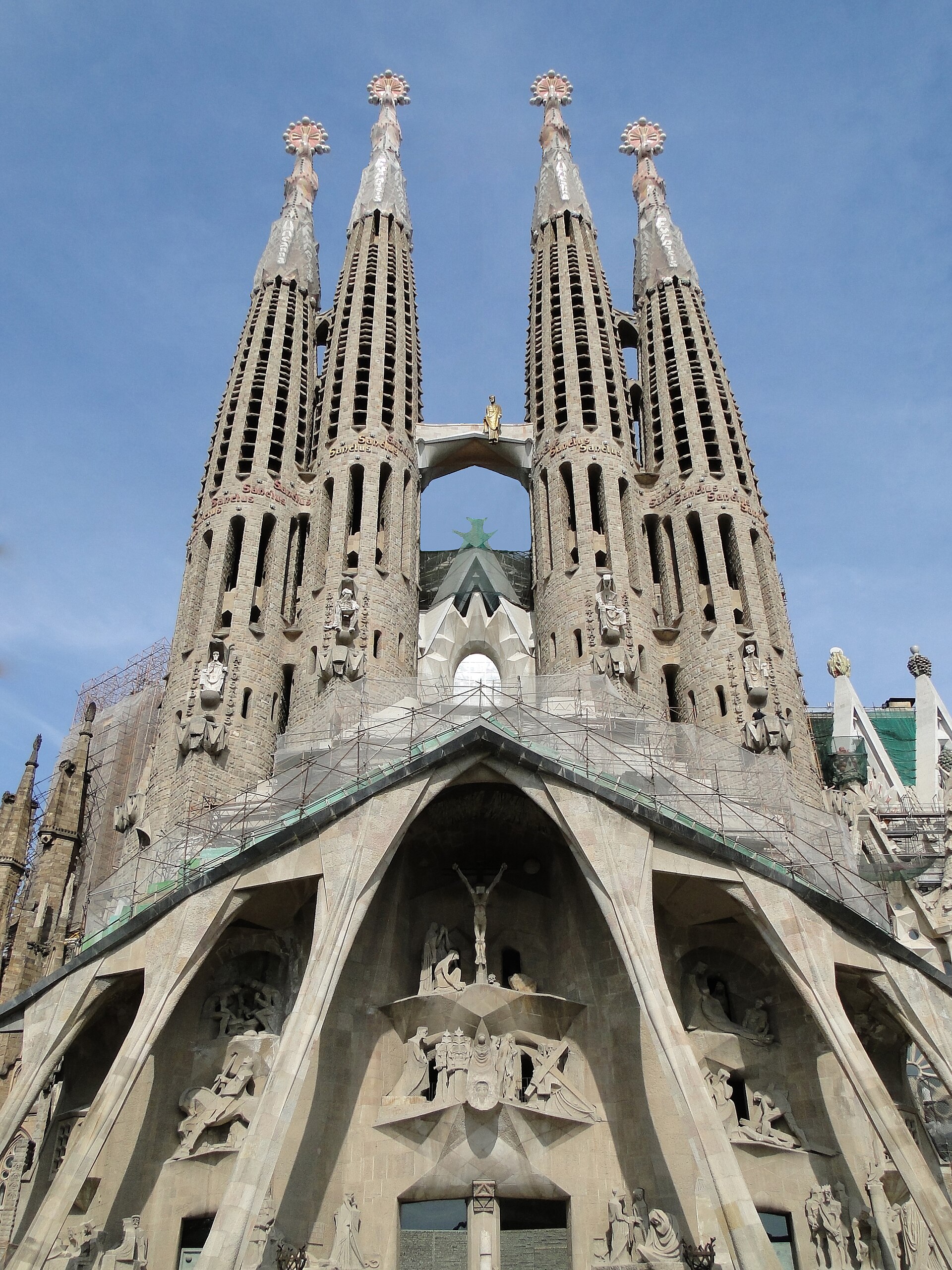
SAGRADA FAMÍLIA · OVERVIEW
Basílica i Temple Expiatori de la Sagrada Família, or simply Sagrada Família, is a Catholic Basilica in the Eixample district of Barcelona, Catalonia, Spain. Designed by the Catalan architect Antoni Gaudí, it is the tallest church
in the world. On 7 November 2010, Pope Benedict XVI consecrated the church and proclaimed it a basilica. In 2005, parts of the Sagrada Família were declared a UNESCO World Heritage Site, under "Works of Antoni Gaudí".
LOCATION ·
41.40369, 2.17433
History
[ edit ] Sagrada Família was inspired by a bookseller, José María Bocabella , founder of Asociación Espiritual de Devotos de San José (Spiritual Association of Devotees of St. Joseph). After a visit to the Vatican in 1872, Bocabella returned from Italy with the intention of building a church inspired by the basilica at Loreto . It was to be an " expiatory temple ", funded entirely by donations from persons seeking to counter a growing rejection of the Catholic Church and its values. The apse crypt of the church was begun on 19 March 1882, on the festival of St. Joseph, to the design of the architect Francisco de Paula del Villar , whose plan was for a Gothic revival church of a standard form. The apse crypt was completed before Villar's resignation on 18 March 1883, when Antoni Gaudí assumed responsibility for its design, which he changed radically. Gaudí began work on the church in November of 1883 but was not appointed Architect Director until 28 March 1884. The Cathedral of the Paupers , by Joaquim Mir , 1898
20th century
[ edit ] On the subject of the extremely long construction period, Gaudí is said to have remarked: "My client is not in a hurry." When Gaudí died in 1926, the basilica was between 15 and 25 percent complete. After Gaudí's death, work continued under the direction of his main disciple Domènec Sugrañes i Gras until interrupted by the Spanish Civil War in 1936. Parts of the unfinished basilica and Gaudí's models and workshop were destroyed during the war. The present design is based on reconstructed versions of the plans that were burned in a fire as well as on modern adaptations. Since 1940, the architects Francesc Quintana, Isidre Puig Boada , Lluís Bonet i Garí and Francesc Cardoner have carried on the work. The illumination was designed by Carles Buïgas . The director until 2012 was the son of Lluís Bonet, Jordi Bonet i Armengol. Armengol began introducing computers into the design and construction process in the 1980s. [ citation needed ]
21st century
[ edit ] New stonework at Sagrada Família (left) is visible against the stained and weathered older sections (right). The central nave vaulting was completed in 2000 and the main tasks since then have been the construction of the transept vaults and apse . In 2002, the Sagrada Família Schools building was relocated from the eastern corner of the site to the southern corner, and began housing an exhibition. The school was originally designed by Gaudí in 1909 for the children of the construction workers. As of 2006 [ update ] , work concentrated on the crossing and supporting structure for the main steeple of Jesus Christ as well as the southern enclosure of the central nave, which will become the Glory façade. Computer-aided design technology has allowed stone to be shaped off-site by a computer numerical control milling machine, whereas in the 20th century the stone was carved by hand. In 2008, some renowned Catalan architects advocated halting construction to respect Gaudí's original designs, which, although they were not exhaustive and were partially destroyed, have been partially reconstructed in the early 21st century. Since 2013, AVE high-speed trains have passed near Sagrada Família through a tunnel that runs beneath the centre of Barcelona. The tunnel's construction, which began on 26 March 2010, was controversial. The Ministry of Public Works of Spain ( Ministerio de Fomento ) said the project posed no risk to the church. Sagrada Família engineers and architects disagreed, saying there was no guarantee that the tunnel would not affect the stability of the building. The Board of the Sagrada Família ( Patronat de la Sagrada Família ) and the neighborhood association AVE pel Litoral (AVE by the Coast) led a campaign against this route for the AVE, without success. [ citation needed ] In October 2010, the tunnel boring machine reached the church underground under the location of the building's principal façade. Service through the tunnel was inaugurated on 8 January 2013. Track in the tunnel makes use of a system by Edilon Sedra in which the rails are embedded in an elastic material to damp vibrations. The main nave was covered and an organ was installed in
Historical photographs of Sagrada Família
[ edit ] 1905 1915 1930. Aerial photograph by Walter Mittelholzer , ETH-Bibliothek . Base of the Christ steeple under construction (2009) 2019