World Heritage Record
Inscribed on the UNESCO World Heritage List in 1987. World Heritage criteria: (i)(ii)(iii)(iv)(v)(vi). Official property area: 70,176.4 ha.
SOURCE · UNESCO World Heritage Centre
Outstanding Universal Value
The UNESCO World Heritage property comprises the city of Venice and its lagoon situated in the Veneto Region of Northeast Italy. Founded in the 5th century AD and spread over 118 small islands, Venice became a major maritime power in the 10th century. The whole city is an extraordinary architectural masterpiece in which even the smallest building contains works by some of the world's greatest artists such as Giorgione, Titian, Tintoretto, Veronese and others.
SOURCE · UNESCO World Heritage Centre
Integrity & Condition
Due to their geographical characteristics, the city of Venice and the lagoon settlements have retained their original integrity of the built heritage, the settlement structure and its interrelation in the lagoon. The boundaries of the city and other lagoon settlements are well circumscribed and delimited by water. Venice has retained its boundaries, the landscape characteristics and the physical and functional relationships with the lagoon environment.
SOURCE · UNESCO World Heritage Centre
Authenticity
The assets of the World Heritage property have substantially retained their original character. The urban structure has predominantly maintained the formal and spatial characters present in the Middle Ages and the Renaissance with a few later additions due to landfills and land reclamation.
SOURCE · UNESCO World Heritage Centre
Protection & Management
The Ministry for Cultural Heritage and
SOURCE · UNESCO World Heritage Centre
Modern age
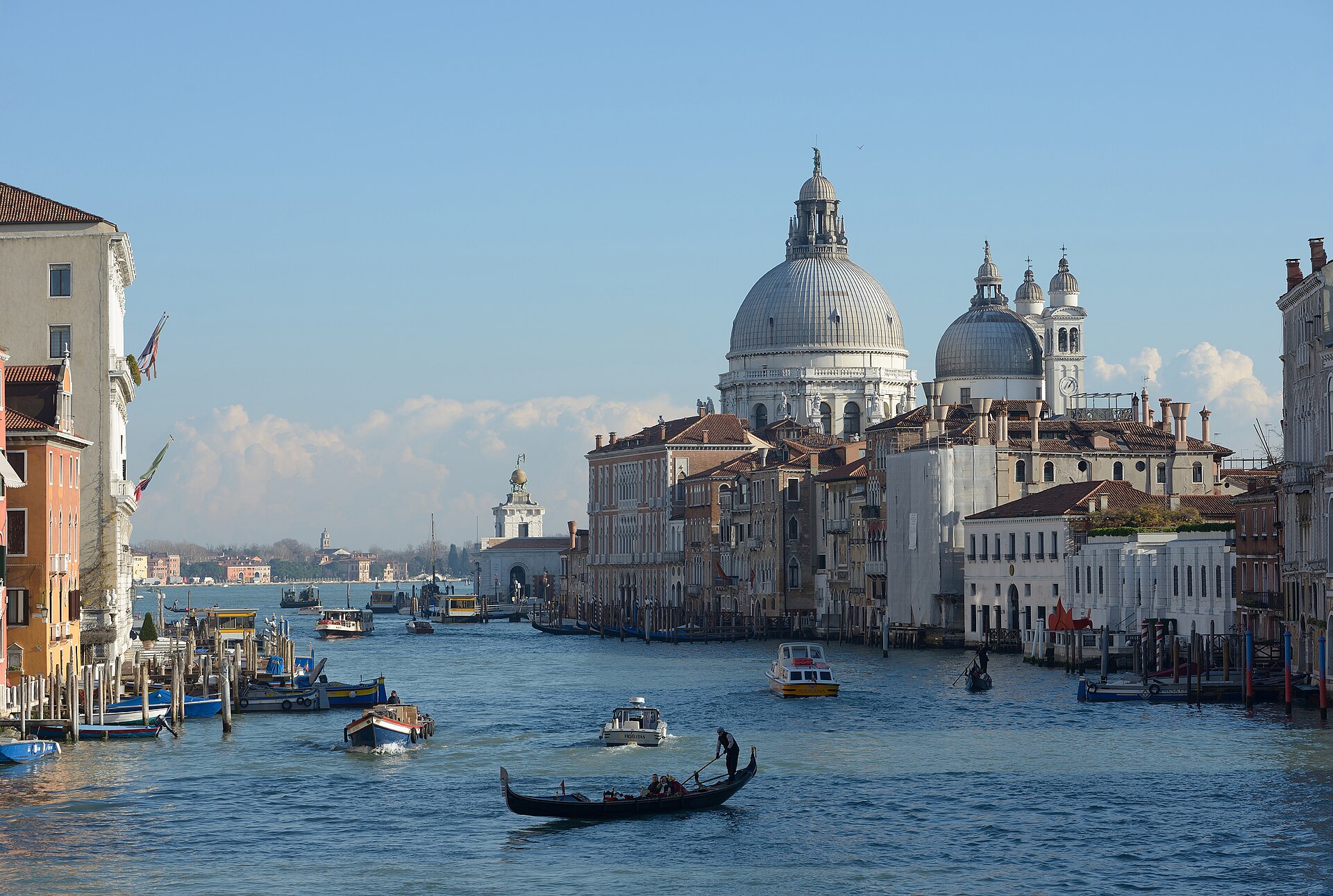
[ edit ] 1870s panoramic view of Venice The Republic of Venice lost its independence when Napoleon Bonaparte conquered Venice on 12 May 1797 during the War of the First Coalition . Napoleon was seen as something of a liberator by the city's Jewish population. He removed the gates of the Ghetto and ended the restrictions on when and where Jews could live and travel within the city. Venice became Austrian territory when Napoleon signed the Treaty of Campo Formio on 12 October 1797. The Austrians took control of the city on 18 January 1798. Venice was taken from Austria by the Treaty of Pressburg in 1805 and became part of Napoleon's Kingdom of Italy . It was returned to Austria following Napoleon's defeat in 1814, when it became part of the Austrian-held Kingdom of Lombardy–Venetia . In 1848, a revolt briefly re-established the Venetian republic under Daniele Manin , but this was crushed in 1849. In 1866, after the Third Italian War of Independence , Venice, along with the rest of the Veneto, became part of the newly created Kingdom of Italy . From the middle of the 18th century, Trieste and papal Ancona , both of which became free ports, competed with Venice more and more economically. Habsburg Trieste in particular boomed and increasingly served trade via the Suez Canal , which opened in 1869, between Asia and Central Europe, while Venice very quickly lost its competitive edge and commercial strength. During World War II , the historic city was largely free from attack, with the only aggressive effort of note being Operation Bowler , a successful Royal Air Force precision strike on the German naval operations in the city in March 1945. The targets were destroyed with virtually no architectural damage inflicted upon the city itself. However, the industrial areas in Mestre and Marghera and the railway lines to Padua, Trieste, and Trento were repeatedly bombed . On 29 April 1945, a force of British and New Zealand troops of the British Eighth Army , under Lieutenant General Freyberg , liberated Venice, which had been a hotbed of anti-Mussolini Italian partisan activity. View of San Giorgio Maggiore from St. Mark's Campanile Grand Canal from Rialto to Ca' Foscari (2
Tourism
[ edit ] The annual trend of tourism sector in Venice from 2013 to 2023 is divided by the number of presences per type of hotel establishments. The total number of presences indicates the number of nights spent by tourists in hotel establishments. The beach of Lido di Venezia Burano, tourist destination usually reached via vaporetto Venice is an important destination for tourists who want to experience its celebrated art and architecture, hosting up to 60,000 tourists per day (2017 estimate). Estimates of the annual number of tourists vary from 22 million to 30 million. This " overtourism " creates overcrowding and environmental problems for Venice's ecosystem. By 2017, UNESCO was considering the addition of Venice to its "In-Danger" list, which includes historical ruins in war-torn countries. To reduce the number of visitors, who are causing irreversible changes in Venice, the agency supports limiting the number of cruise ships as well as implementing a strategy for more sustainable tourism . Tourism has been a major part of the Venetian economy since the 18th century, when Venice – with its beautiful cityscape, uniqueness, and rich musical and artistic cultural heritage – was a stop on the Grand Tour . In the 19th century, Venice became a fashionable centre for the rich and famous, who often stayed and dined at luxury establishments such as the Danieli Hotel and the Caffè Florian , and continued to be a fashionable city into the early 20th century. In the 1980s, the Carnival of Venice was revived, and the city has become a major centre of international conferences and festivals, such as the prestigious Venice Biennale and the Venice Film Festival , which attract visitors from all over the world for their theatrical, cultural, cinematic, artistic, and musical productions. Today, there are numerous attractions in Venice, such as St. Mark's Basilica , the Doge's Palace , the Grand Canal , and the Piazza San Marco . The Lido di Venezia is also a popular international luxury destination, attracting thousands of actors, critics, celebrities, and others in the cinematic industry. The city also relies heavily on the cruise business. The Cruise Venice Committee has est