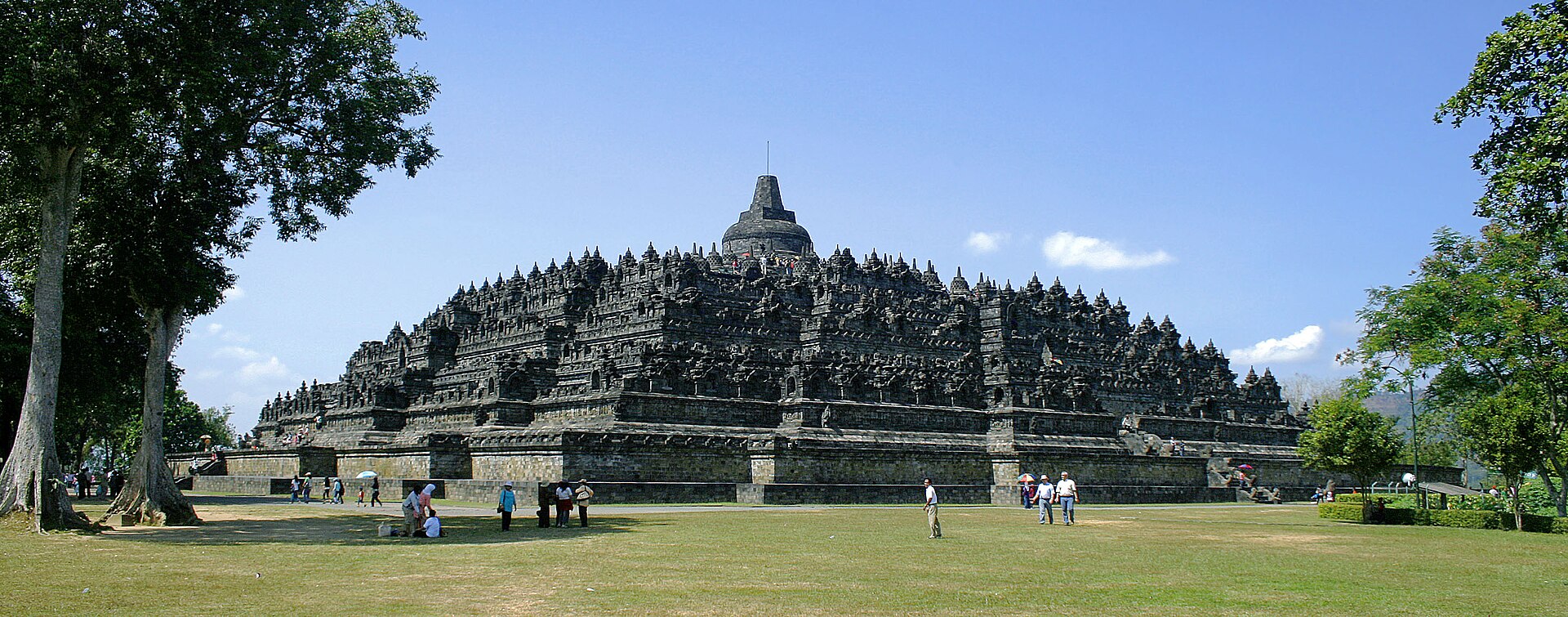
BOROBUDUR · OVERVIEW
Borobudur, also transcribed Barabudur, is a 9th-century Mahayana Buddhist temple in Magelang Regency, near the town of Muntilan, northwest of the city of Yogyakarta, in Central Java, Indonesia.
LOCATION ·
-7.60800, 110.20400
Construction
[ edit ] A painting by G.B. Hooijer (c. 1916–1919) reconstructing the scene of Borobudur during its heyday Hindu clerics appealed to the people of Java for generations, a fact that architect and author Jacques Dumarçay finds first mentioned in 450 AD. Influence of the Sailendra and Sanjaya dynasties followed. Dumarçay says that de Casparis concluded that Sanjaya and Sailendra shared power in central Java for a century and a half, and that de Casparis traced alternating succession from 732 until 882. During this time many Hindu and Buddhist monuments were built on the plains and mountains around the Kedu Plain. Buddhist monuments, including Borobudur, were erected around the same period as the Hindu Prambanan temple compound. In 732 AD, King Sanjaya commissioned a Shivalinga sanctuary to be built on the Wukir hill, only 10 km (6.2 mi) east of Borobudur. There are no known records of construction or the intended purpose of Borobudur. The duration of construction has been estimated by comparison of carved reliefs on the temple's hidden foot and the inscriptions commonly used in royal charters during the 8th and 9th centuries. Comparison of an Indian architectural process across temples, and acknowledgment of who was in power, enabled Dumarçay to approximately date the construction of Borobudur in five stages. Loosely, the Sailendra began c. 780 , and continued stages two and three c. 792 through to an unremarkable fourth stage during their decline c. 824 . The Sanjaya completed Borobudur's fifth stage c. 833 . [ a ] Construction of Buddhist temples, including Borobudur, at that time was possible because Sanjaya's immediate successor, Rakai Panangkaran , granted his permission to the Buddhist followers to build such temples. In fact, to show his respect, Panangkaran gave the village of Kalasan to the Buddhist community, as is written in the Kalasan Charter dated 779 AD. This has led some archaeologists to believe that there was never serious conflict concerning religion in Java as it was possible for a Hindu king to patronize the establishment of a Buddhist monument; or for a Buddhist king to act likewise. The 856 battle on the Ratubaka plateau was much after and wa
Similarities with the Kesaria site
[ edit ] Main article: Kesaria Stupa There are quite a few design similarities between the Borobudur and Kesaria sites. Both sites have mandalas and life like Buddhas facing the sections of the universe. Both sites have hill-like mandala structures filled with Buddhist statues. This hints at the travel of ritualistic texts and ideas between the Pala and Srivijaya domains.
Etymology
[ edit ] Candi Borobudur viewed from the northwest. The monument was mentioned in the Karangtengah and Tri Tepusan inscriptions . In Indonesian , ancient temples are referred to as candi ; thus locals refer to "Borobudur Temple" as Candi Borobudur . The term candi also loosely describes ancient structures, for example, gates and baths. Dutch scholar J. L. Moens says the court poet Mpu Prapanca referred to a holy sanctuary at "Budur" in 1365. Stamford Raffles mentioned "Bóro Bódo" and described the temple in his 1817 work, The History of Java . In a footnote, Raffles says, "Bóro is the name of the district, and bódo means ancient." Most candi are named after a nearby village. If it followed Javanese language conventions and was named after the nearby village of Bore , the monument should have been named "BudurBoro". Soekmono says Raffles thought that Budur might correspond to the modern Javanese word Buda ("ancient")—i.e., "ancient Boro". However, another archaeologist suggests the second component of the name ( Budur ) comes from Javanese term bhudhara ("mountain"). Another possible etymology by Dutch archaeologist A. J. Bernet Kempers suggests that Borobudur is a corrupted simplified local Javanese pronunciation of Biara Beduhur written in Sanskrit as Vihara Buddha Uhr . The term Buddha-Uhr could mean "the city of Buddhas", while another possible term Beduhur is probably an Old Javanese term, still surviving today in Balinese vocabulary, which means "a high place", constructed from the stem word dhuhur or luhur (high). This suggests that Borobudur means vihara of Buddha located on a high place or on a hill. The construction and inauguration of a sacred Buddhist building—possibly a reference to Borobudur—was mentioned in two inscriptions, both discovered in Kedu, Temanggung Regency . The Karangtengah inscription , dated 824, mentioned a sacred building named Jinalaya (the realm of those who have conquered worldly desire and reached enlightenment), inaugurated by Pramodhawardhani , daughter of Samaratungga . The Tri Tepusan inscription , dated 842, is mentioned in the sima , the (tax-free) lands awarded by Çrī Kahulunnan (Pramodhawardhani) to ensure the funding a
The three temples
[ edit ] See also: Borobudur Temple Compounds Straight-line arrangement of Borobudur, Pawon, and Mendut Borubudur is located approximately 40 kilometres (25 mi) northwest of Yogyakarta and 86 kilometres (53 mi) west of Surakarta . It is also located in an elevated area between twin volcanoes, Sindoro - Sumbing and Merbabu - Merapi , and two rivers, the Progo and the Elo. According to local myth, the area known as Kedu Plain is a Javanese " sacred" place and has been dubbed "the garden of Java" due to its high agricultural fertility . During the restoration in the early 20th century, Theodoor van Erp [ nl ] discovered that three Buddhist temples in the region, Borobudur, Pawon and Mendut , are positioned along a straight line from east to west. Jan Lodewijk Moens hypothesized a ritual connecting the three temples. However, the exact process remains unknown due to a lack of written records about the ritual. He hypothesized that the ritual was done by doing pilgrimage following the sun path where it starting with Borobudur as the sunset following with Pawon as the zenith and ending with Mendut as the sunrise. Giulio Magli also identified that the ritual is following the event of the zennith passage that happening on October 11 and February 28. He also compared Borubudur with One Hundred and Eight Stupas where the building itself is built around ritual related to the winter solstice . In 1991, the three temples was designated as world heritage site by UNESCO under the name Borubudur Temple Compounds.