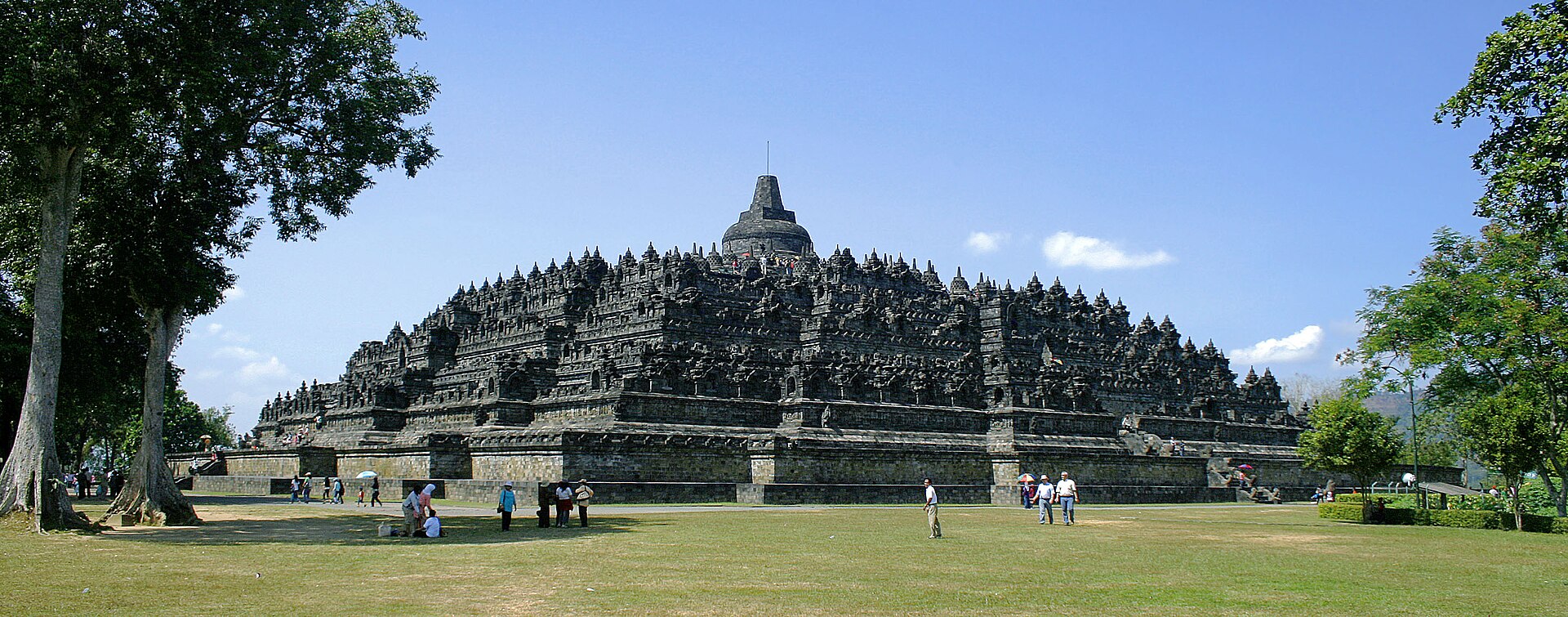
BOROBUDUR · OVERVIEW
Borobudur, also transcribed Barabudur, is a 9th-century Mahayana Buddhist temple in Magelang Regency, near the town of Muntilan, northwest of the city of Yogyakarta, in Central Java, Indonesia.
LOCATION ·
-7.60800, 110.20400
World Heritage Record
Inscribed on the UNESCO World Heritage List in 1991. World Heritage criteria: (i)(ii)(vi). Official property area: 25.51 ha.
SOURCE · UNESCO World Heritage Centre
Outstanding Universal Value
The Borobudur Temple Compounds is one of the greatest Buddhist monuments in the world, and was built in the 8th and 9th centuries AD during the reign of the Syailendra Dynasty. The monument is located in the Kedu Valley, in the southern part of Central Java, at the centre of the island of Java, Indonesia. The main temple is a stupa built in three tiers around a hill which was a natural centre: a pyramidal base with five concentric square terraces, the trunk of a cone with three circular platforms and, at the top, a monumental stupa.
SOURCE · UNESCO World Heritage Centre
Authenticity
The original materials were used to reconstruct the temple in two phases in the 20th century: after the turn of the century and more recently (1973-1983). Mostly original materials were used with some additions to consolidate the monument and ensure proper drainage which has not had any significant adverse impact on the value of the property.
SOURCE · UNESCO World Heritage Centre
Protection & Management
The protection of the property is performed under Indonesian Law No. 11/2010 concerning Cultural Heritage and its surrounding cultural landscape. It is executed under a National Strategic Area and the Spatial Management Plan by the Ministry of Public Works in accordance with the Law concerning Spatial Management No.
SOURCE · UNESCO World Heritage Centre
Restoration
[ edit ] Borobudur after van Erp's restoration in 1911. The chhatra pinnacle is now dismantled. The Unfinished Buddha (front) and the main stupa's chhatra (rear) at Karmawibhangga Museum Water spout of drainage systems in Borobudur temple Concrete and PVC pipe improve drainage system (1973) Borobudur attracted attention in 1885, when the Dutch engineer Jan Willem IJzerman [ id ; nl ] , chairman of the Archaeological Society in Yogyakarta, discovered that the temple base enclosed a hidden foot. Photographs made in 1890–1891 revealed reliefs on the hidden foot; the coverings were then replaced. The discovery led the Dutch East Indies government to take steps to safeguard the monument. In 1900, a three-member commission formed to plan protection, and in 1902, the commission submitted a threefold proposal. First, collapse could be avoided by resetting the corners, removing stones that endangered the adjacent parts, strengthening the first balustrades and restoring several niches, archways, stupas and the main dome. Second, care should be maintained and water discharge should be improved by restoring floors and spouts. Third, all loose stones should be removed, the monument cleared up to the first balustrades, disfigured stones removed and the main dome restored. In 1905, the proposal was approved, and the total cost was estimated at that time around 48,800 Dutch guilders (equivalent to ƒ 1,723,019 in 2022 ). The restoration began in 1907, led by Theodoor van Erp [ nl ] , a Dutch army engineer. The first seven months of restoration were occupied with excavating the grounds around the monument to find missing Buddha heads and panel stones. Van Erp dismantled and rebuilt the upper three circular platforms and stupas. Along the way, van Erp discovered more things he could do to improve the monument; he submitted another proposal in 1908, which was approved with the additional budget of 34,600 guilders (equivalent to ƒ 1,137,702 in 2022 ). The restoration was completed in 1911 and at first glance, Borobudur had been restored to its old glory. Van Erp went further by carefully reconstructing the chattra (three-tiered parasol) pinnacle on top of the main stupa. However, he
Tourism
[ edit ] The monument is the single most visited tourist attraction in Indonesia . In 1974, 260,000 tourists visited the monument; 36,000 of them were foreigners. The figure climbed to 2.5 million visitors annually (80% were domestic tourists) in the mid-1990s, before the country's economic crisis . Tourism development, however, has been criticized for not including the local community, giving rise to occasional conflicts. In 2003, residents and small businesses around Borobudur organized several meetings and poetry protests, objecting to a provincial government plan to build a three-storey mall complex, dubbed "Java World". In June 2012, Borobudur was recorded in the Guinness Book of World Records as the world's largest Buddhist temple.
Conservation
[ edit ] Buddhist monks chant on the top platform UNESCO identified three specific areas of concern under the present state of conservation: (i) vandalism by visitors; (ii) soil erosion in the south-eastern part of the site; and (iii) analysis and restoration of missing elements. The soft soil, the numerous earthquakes and heavy rains lead to the destabilization of the structure. Earthquakes are by far the most important contributing factors, since not only do stones fall down and arches crumble, but the earth itself can move in waves, further destroying the structure. The increasing popularity of the stupa brings in many visitors, most of whom are from Indonesia. Despite warning signs on all levels not to touch anything, the regular transmission of warnings over loudspeakers and the presence of guards, vandalism on reliefs and statues is a common occurrence and problem, leading to further deterioration.