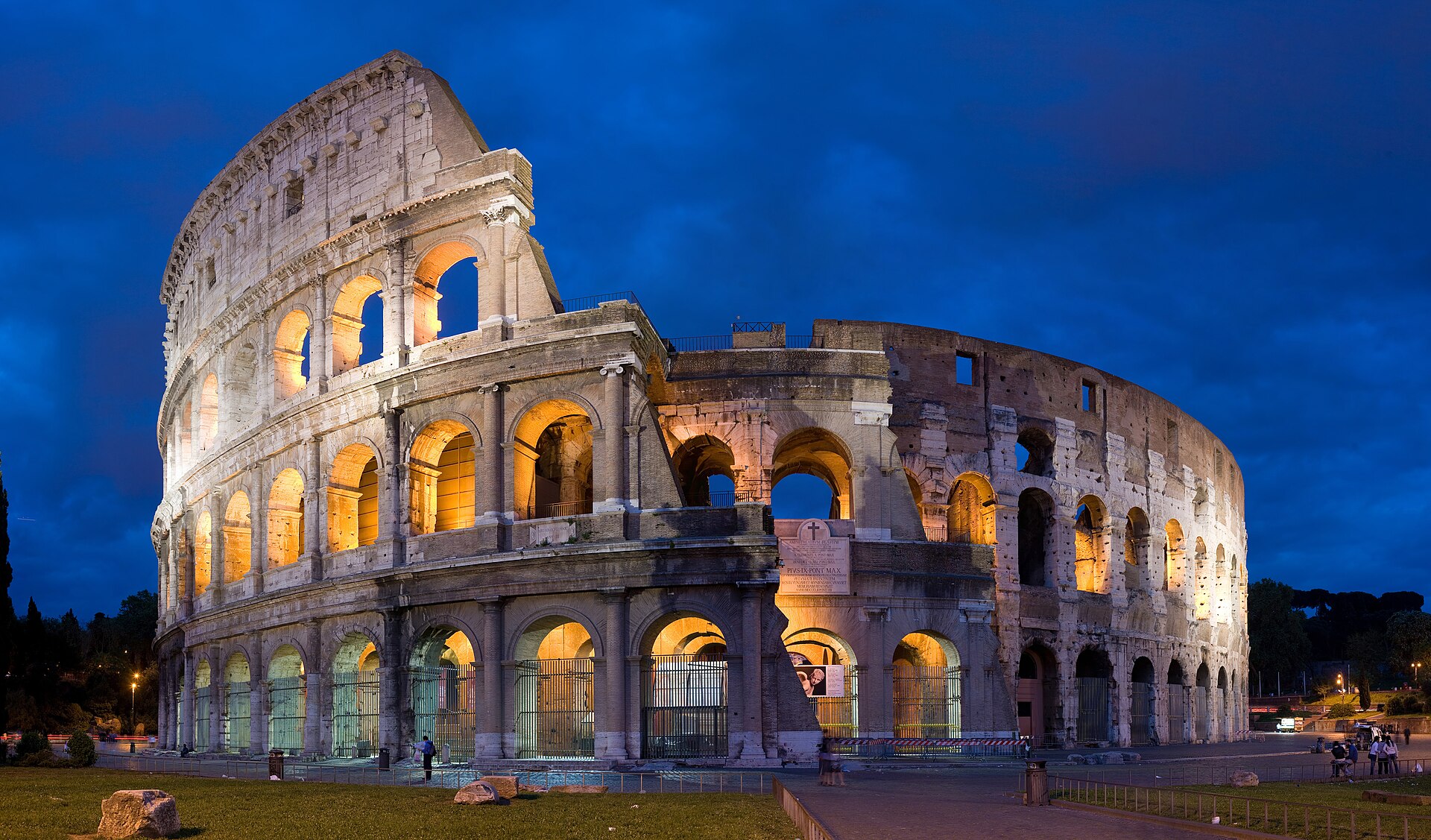
COLOSSEUM · OVERVIEW
The Colosseum is an elliptical amphitheatre in the centre of the city of Rome, Italy, just east of the Roman Forum. It is the largest ancient amphitheatre ever built, and is the largest standing amphitheatre in the world. Construction began under the Emperor Vespasian in 72 and was completed in AD 80 under his successor and heir, Titus. Further modifications were made during the reign of Domitian. The three emperors who were patrons of the work are known as the Flavian dynasty, and the amphitheatre was named the Flavian Amphitheatre by later classicists and archaeologists for its association with their family name (Flavius).
LOCATION ·
41.89030, 12.49220
Construction, inauguration, and Roman renovations
[ edit ] Sestertius of Titus celebrating the inauguration of the Colosseum (minted 80 AD). A map of central Rome during the Roman Empire, with the Colosseum at the upper right corner The site chosen was a flat area on the floor of a low valley between the Caelian , Esquiline and Palatine Hills , through which a canalised stream ran as well as an artificial lake/marsh. By the 2nd century BC the area was densely inhabited. It was devastated by the Great Fire of Rome in 64 AD, following which Nero seized much of the area to add to his personal domain. He built the grandiose Domus Aurea on the site, in front of which he created an artificial lake surrounded by pavilions, gardens and porticoes. The existing Aqua Claudia aqueduct was extended to supply water to the area and the gigantic bronze Colossus of Nero was set up nearby at the entrance to the Domus Aurea. Although the Colossus was preserved, much of the Domus Aurea was torn down. The lake was filled in and the land reused as the location for the new Flavian Amphitheatre. Gladiatorial schools and other support buildings were constructed nearby within the former grounds of the Domus Aurea. Vespasian's decision to build the Colosseum on the site of Nero's lake can be seen as a populist gesture of returning to the people an area of the city which Nero had appropriated for his own use. In contrast to many other amphitheatres, which were on the outskirts of a city, the Colosseum was constructed in the city centre, in effect, placing it both symbolically and geographically at the heart of Rome. Cross-section from the Lexikon der gesamten Technik (1904) Construction was funded by the opulent spoils taken from the Jewish Temple after the First Jewish–Roman War in 70 AD led to the Siege of Jerusalem . According to a reconstructed inscription found on the site, "the emperor Vespasian ordered this new amphitheatre to be erected from his general's share of the booty." It is often assumed, as it is with many other Roman projects at the time, that slaves and prisoners of war were brought back to Rome and contributed to the massive workforce needed for the construction of the amphitheater. Along with this free source of unski
Name
[ edit ] Originally, the building's Latin name was simply amphitheatrum , ' amphitheatre ' . Though the modern name Flavian Amphitheatre ( Latin : Amphitheatrum Flavium ) is often used, there is no evidence it was used in classical antiquity . This name refers to the patronage of the Flavian dynasty , during whose reigns the building was constructed, but the structure is better known as the Colosseum. In antiquity, Romans may have referred to the Colosseum by the unofficial name Amphitheatrum Caesareum (with Caesareum an adjective pertaining to the title Caesar ), but this name may have been strictly poetic as it was not exclusive to the Colosseum; Vespasian and Titus, builders of the Colosseum, also constructed a Flavian Amphitheatre in Puteoli (modern Pozzuoli). Interior of the Colosseum by late nineteenth century photographer Francis Frith The name Colosseum is believed to be derived from a colossal statue of Nero on the model of the Colossus of Rhodes . The giant bronze sculpture of Nero as a solar deity was moved to its position beside the amphitheatre by the emperor Hadrian ( reigned</span>"}]]}'>r. 117–138 ). The word colosseum is a neuter Latin noun formed from the adjective colosseus , meaning "gigantic" or "colossean". By the year 1000 the Latin name "Colosseum" had been coined to refer to the amphitheatre from the nearby "Colossus Solis". In the 8th century, an epigram attributed to the Venerable Bede celebrated the symbolic significance of the statue in a prophecy that is variously quoted: Quamdiu stat Colisæus, stat et Roma; quando cadet colisæus, cadet et Roma; quando cadet Roma, cadet et mundus ("as long as the Colossus stands, so shall Rome; when the Colossus falls, Rome shall fall; when Rome falls, so falls the world"). This is often mistranslated to refer to the Colosseum rather than the Colossus (as in, for instance, Byron 's poem Childe Harold's Pilgrimage ). However, at the time that the Pseudo-Bede wrote, the masculine noun coliseus was applied to the statue rather than to the amphitheatre. The spelling was sometimes altered in Medieval Latin : coloseum and coliseum are attested from the 12th and 14th centuries respectively. In the 12th cen
Medieval
[ edit ] Map of medieval Rome depicting the Colosseum The Colosseum underwent several radical changes of use. By the late 6th century a small chapel had been built into the structure of the amphitheater, though this apparently did not confer any particular religious significance on the building as a whole. The arena was converted into a cemetery. The numerous vaulted spaces in the arcades under the seating were converted into housing and workshops, and are recorded as still being rented out as late as the 12th century. Around 1200 the Frangipani family took over the Colosseum and fortified it, apparently using it as a castle. In the early to mid 14th century, the Pope's relocation to Avignon caused a population decline in Rome that left the region insecure. The colosseum was largely abandoned by the public and became a popular den for bandits. Severe damage was inflicted on the Colosseum by the great earthquake in 1349 , causing the outer south side, lying on a less stable alluvial terrain, to collapse. Much of the tumbled stone was reused to build palaces, churches, hospitals and other buildings elsewhere in Rome. In 1377, after the Pope's return to Rome, the Colosseum was restored by a religious order called Arciconfraternita del SS. Salvatore ad Sancta Sanctorum, who then inhabited a northern portion of it until as late as the early 19th century. The interior of the amphitheater was extensively stripped of stone, which was reused elsewhere, or (in the case of the marble façade) was burned to make quicklime . The iron clamps which held the stonework together were pried or hacked out of the walls, leaving numerous pockmarks which still scar the building today.
Modern
[ edit ] The Colosseum in the 1530s, sketched by Maarten van Heemskerck , and used as the model for his later Self-Portrait with the Colosseum and Octo Mundi Miracula . Overview of the interior of the Colosseum in a 1776 engraving by Giovanni Battista Piranesi 1870 view emphasizing the semi-rural environs of the Colosseum at the time During the 16th and 17th century, Church officials sought a productive role for the Colosseum. Pope Sixtus V (1585–1590) planned to turn the building into a wool factory to provide employment for Rome's prostitutes, though this proposal fell through with his premature death. In 1671, Cardinal Paluzzo Altieri authorized its use for bullfights ; a public outcry caused the idea to be hastily abandoned. Allied troops consult a guidebook outside the Colosseum after liberation in 1944 In 1749, Pope Benedict XIV endorsed the view that the Colosseum was a sacred site where early Christians had been martyred . He forbade the use of the Colosseum as a quarry and consecrated the building to the Passion of Christ and installed Stations of the Cross , declaring it sanctified by the blood of the Christian martyrs who perished there ( see Significance in Christianity ). However, there is no historical evidence to support Benedict's claim, nor is there even any evidence that anyone before the 16th century suggested this might be the case; the Catholic Encyclopedia concludes that there are no historical grounds for the supposition, other than the reasonably plausible conjecture that some of the many martyrs may well have been martyred there. Interior of the Colosseum, Rome (1832) by Thomas Cole , showing the Stations of the Cross around the arena and the extensive vegetation Eastern interior (viewed from west), 2023 Later popes initiated various stabilization and restoration projects, removing the extensive vegetation which had overgrown the structure and threatened to damage it further. The façade was reinforced with triangular brick wedges in 1807 and 1827, and the interior was repaired in 1831, 1846 and in the 1930s. The arena substructure was partly excavated in 1810–1814 and 1874 and was fully exposed under Benito Mussolini in the 1930s. The Co