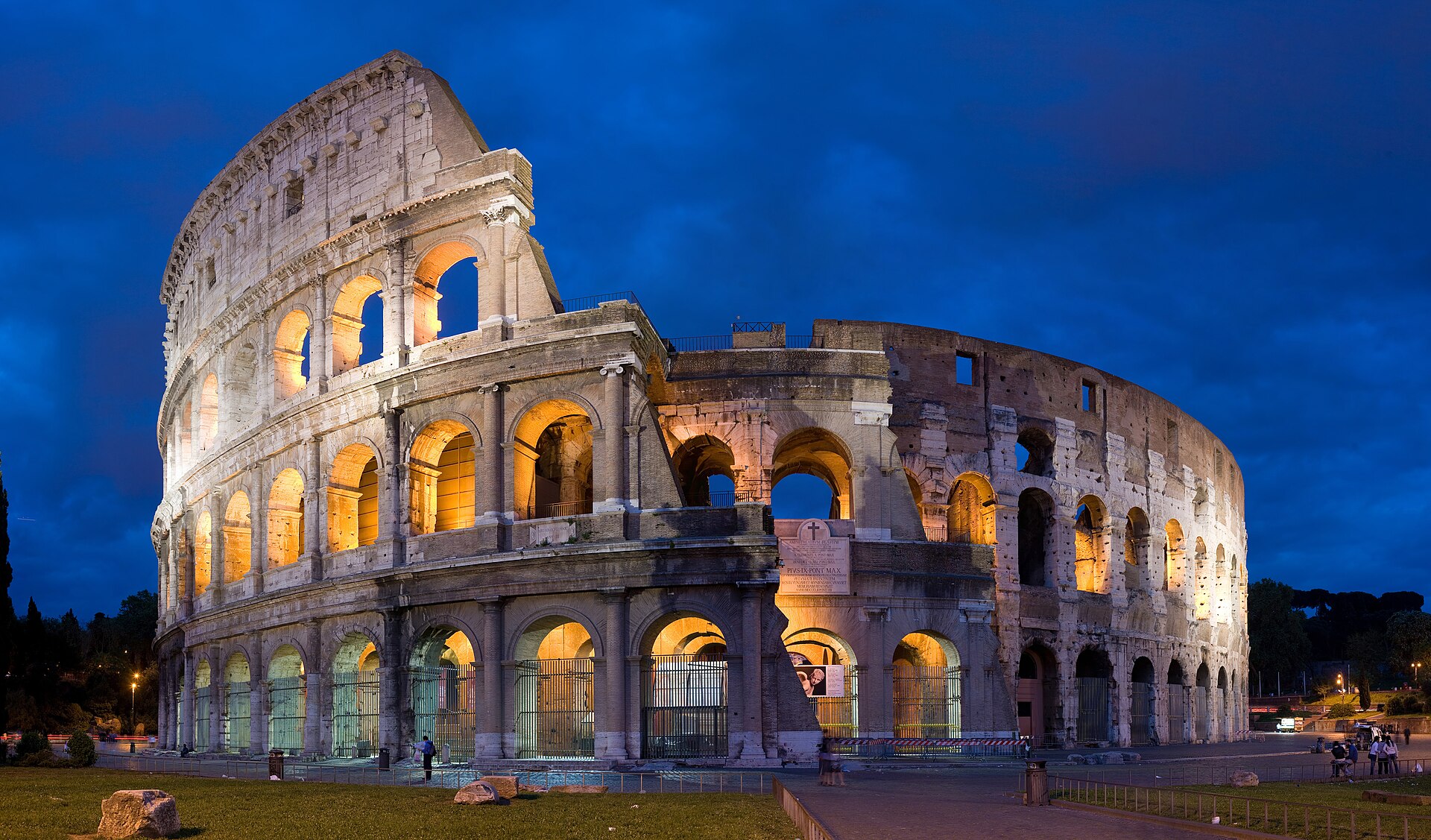
COLOSSEUM · OVERVIEW
The Colosseum is an elliptical amphitheatre in the centre of the city of Rome, Italy, just east of the Roman Forum. It is the largest ancient amphitheatre ever built, and is the largest standing amphitheatre in the world. Construction began under the Emperor Vespasian in 72 and was completed in AD 80 under his successor and heir, Titus. Further modifications were made during the reign of Domitian. The three emperors who were patrons of the work are known as the Flavian dynasty, and the amphitheatre was named the Flavian Amphitheatre by later classicists and archaeologists for its association with their family name (Flavius).
LOCATION ·
41.89030, 12.49220
Modern
[ edit ] The Colosseum in the 1530s, sketched by Maarten van Heemskerck , and used as the model for his later Self-Portrait with the Colosseum and Octo Mundi Miracula . Overview of the interior of the Colosseum in a 1776 engraving by Giovanni Battista Piranesi 1870 view emphasizing the semi-rural environs of the Colosseum at the time During the 16th and 17th century, Church officials sought a productive role for the Colosseum. Pope Sixtus V (1585–1590) planned to turn the building into a wool factory to provide employment for Rome's prostitutes, though this proposal fell through with his premature death. In 1671, Cardinal Paluzzo Altieri authorized its use for bullfights ; a public outcry caused the idea to be hastily abandoned. Allied troops consult a guidebook outside the Colosseum after liberation in 1944 In 1749, Pope Benedict XIV endorsed the view that the Colosseum was a sacred site where early Christians had been martyred . He forbade the use of the Colosseum as a quarry and consecrated the building to the Passion of Christ and installed Stations of the Cross , declaring it sanctified by the blood of the Christian martyrs who perished there ( see Significance in Christianity ). However, there is no historical evidence to support Benedict's claim, nor is there even any evidence that anyone before the 16th century suggested this might be the case; the Catholic Encyclopedia concludes that there are no historical grounds for the supposition, other than the reasonably plausible conjecture that some of the many martyrs may well have been martyred there. Interior of the Colosseum, Rome (1832) by Thomas Cole , showing the Stations of the Cross around the arena and the extensive vegetation Eastern interior (viewed from west), 2023 Later popes initiated various stabilization and restoration projects, removing the extensive vegetation which had overgrown the structure and threatened to damage it further. The façade was reinforced with triangular brick wedges in 1807 and 1827, and the interior was repaired in 1831, 1846 and in the 1930s. The arena substructure was partly excavated in 1810–1814 and 1874 and was fully exposed under Benito Mussolini in the 1930s. The Co
Modern use
[ edit ] Aerial view of the Colosseum, 2021 Beneath the Colosseum, a network of subterranean passageways that were once used for transporting wild animals and gladiators to the arena, opened to the public in summer 2010. The Colosseum is also the site of Roman Catholic ceremonies in the 20th and 21st centuries. For instance, Pope Benedict XVI led the Stations of the Cross called the Scriptural Way of the Cross (which calls for more meditation) at the Colosseum on Good Fridays .
Restoration
[ edit ] Colosseum under renovation, 2015 In 2011, Diego Della Valle , head of the shoe firm Tod's , entered into an agreement with local officials to sponsor a €25 million restoration of the Colosseum. Work was planned to begin at the end of 2011, taking up to two and a half years. Due to the controversial nature of using a public–private partnership to fund the restoration, work was delayed and began in 2013. The restoration is the first full cleaning and repair in the Colosseum's history. The first stage is to clean and restore the Colosseum's arcaded façade and replace the metal enclosures that block the ground-level arches. After three years, the work was completed on 1 July 2016, when the Italian minister of culture, Dario Franceschini, also announced that the funds have been committed to replace the floors by the end of 2018. These will provide a stage that Franceschini says will be used for "cultural events of the highest level." The project also includes creating a services center and restoring the galleries and underground spaces inside the Colosseum. Since 2017, the top two levels have been opened for guided visits. The fourth level held the marketplace, and the top fifth tier is where the poorest citizens, the plebeians, gathered and watched the show, bringing picnics for the day-long event.