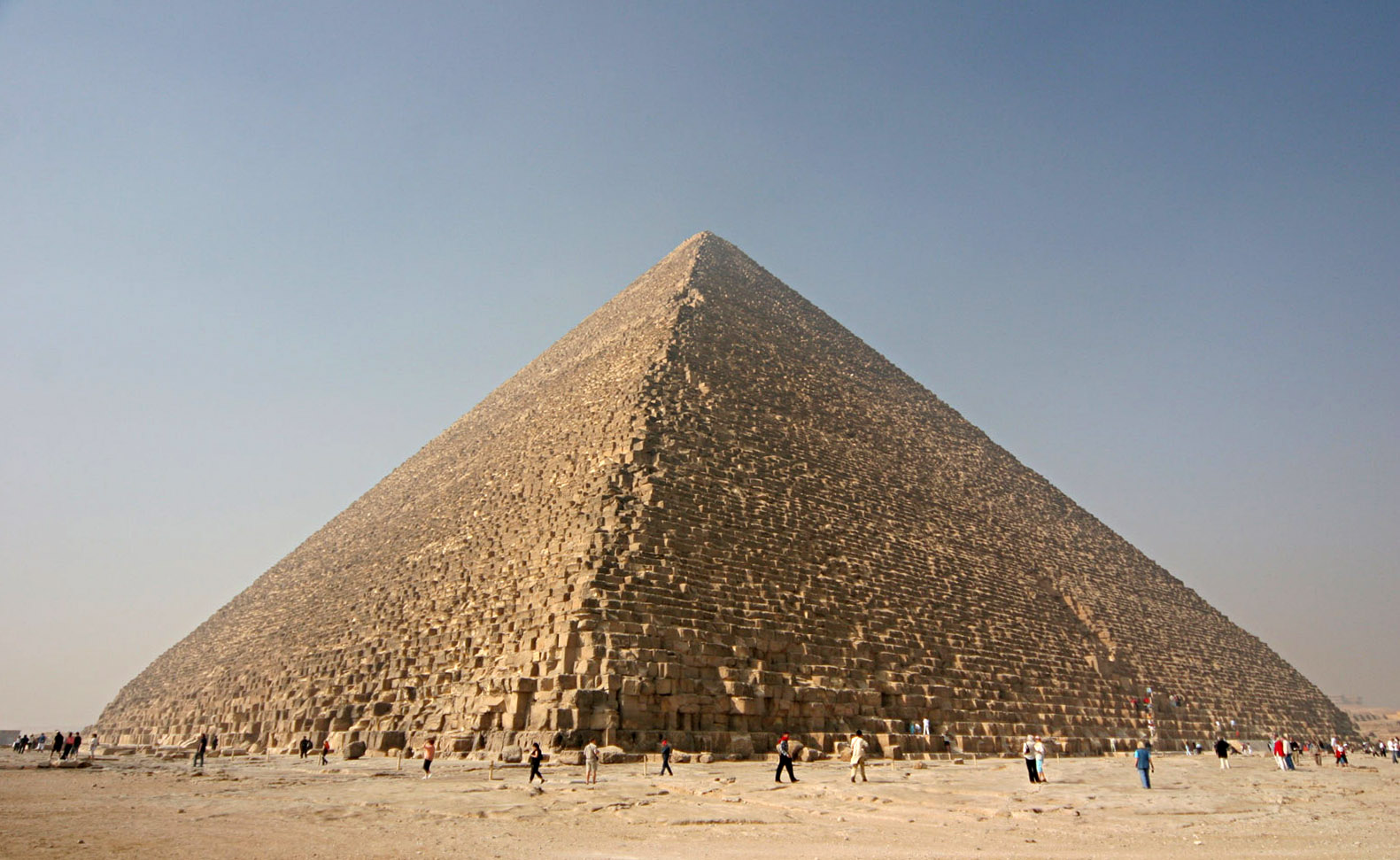
GREAT PYRAMID OF GIZA · OVERVIEW
The Great Pyramid of Giza is the largest of the Egyptian pyramids and the most famous landmark of the Giza pyramid complex in Giza, Egypt. It is the oldest of the Seven Wonders of the Ancient World, and the only wonder that has remained largely intact. The Great Pyramid served as the tomb of Egyptian Pharaoh Khufu ("Cheops"), who ruled during the Fourth Dynasty of the Old Kingdom. It was built c. 2600 BC over a period of about 26 years.
LOCATION ·
29.97917, 31.13417
Purpose
[ edit ] Statue of pharaoh Khufu /Cheops, Cairo Museum . The Great Pyramid of Giza was the tomb of pharaoh Khufu, and still contains his granite sarcophagus. It had, like other tombs of Egyptian elites, four main purposes: It housed the body of the deceased and kept it safe. It demonstrated the status of the deceased and his family. It retained the deceased's place in society. It was a place where offerings could be brought to the deceased. Make your grave well furnished and prepare thy place in the west. Look, death counts little for us. Look, life is valued highly by us. The house of the dead (the tomb) is for life. — Excerpt from the Instruction of Hardjedef (son of Khufu) In ancient Egypt, high social status was considered absolutely positive, and the monumental social inequalities were symbolized by gigantic pyramids versus smaller mastabas . The sizes of tombs were regulated officially, with their allowed dimensions written down in royal decrees . In the Old Kingdom only kings and queens could have a pyramid tomb. Architectural layout and funeral equipment were also sanctioned, and were, like access to material and workers, at the discretion of the king. The Great Pyramid's internal chambers lack inscriptions and decorations, the norm for Egyptian tombs of the fourth to late fifth dynasty, apart from work-gang graffiti that include Khufu's names. Constructed around 2600 BC, it predates the custom of inscribing pyramids with text by over 200 years. The pyramid complex of Khufu included two temples that were lavishly decorated and inscribed. The pyramid temple was dedicated to the Sed festival , celebrating Khufu's 30th jubilee. Surviving scenes portray Khufu, officials, priests and other characters performing rituals. The valley temple remains largely unexcavated, but blocks reused by Amenemhat I depict, for instance, nautical scenes and personifications of the estates of Khufu (e.g. the estate "Khufu is beautiful"). The mortuary cult of Khufu which operated in these temples for hundreds of years indicates that Khufu was successfully interred in the Great Pyramid. That the funeral was carried out by Khufu's son and successor Djedefre is evidenced by the pre
Radiocarbon dating
[ edit ] Specimen of mortar from between core blocks of the Great Pyramid Mortar was used generously in the Great Pyramid's construction. In the mixing process ashes from fires were added to the mortar, organic material that could be extracted and radiocarbon dated . A total of 46 samples of the mortar were taken in 1984 and 1995, making sure they were clearly inherent to the original structure and could not have been incorporated at a later date. The results were calibrated to 2871–2604 BC. The old wood problem is thought to be mainly responsible for the 100–300 year offset, since the age of the organic material was determined, not when it was last used. A reanalysis of the data gave a completion date for the pyramid between 2620 and 2484 BC, based on the younger samples. In 1872 Waynman Dixon opened the lower pair of "Air-Shafts", previously closed at both ends, by chiseling holes into the walls of the Queen's Chamber. One of the objects found within was a cedar plank, which came into possession of James Grant, a friend of Dixon. After inheritance it was donated to the Museum of Aberdeen in 1946; however, it had broken into pieces and was filed incorrectly. Lost in the vast museum collection, it was only rediscovered in 2020, when it was radiocarbon dated to 3341–3094 BC, over 500 years older than Khufu's chronological age. Abeer Eladany suggests that the wood originated from the centre of a long-lived tree or had been recycled for many years prior to being deposited in the pyramid.
History of dating Khufu and the Great Pyramid
[ edit ] Circa 450 BC Herodotus attributed the Great Pyramid to Cheops (Hellenization of Khufu), yet erroneously placed his reign following the Ramesside period . Manetho , around 200 years later, composed an extensive list of Egyptian kings, which he divided into dynasties, assigning Khufu to the 4th. However, after phonetic changes in the Egyptian language and consequently the Greek translation, "Cheops" had transformed into "Souphis" (and similar versions). Greaves , in 1646, reported the great difficulty of ascertaining a date for the pyramid's construction based on the lacking and conflicting historic sources. Because of the differences in spelling, he did not recognize Khufu on Manetho's king list (as transcribed by Africanus and Eusebius ), [ full citation needed ] hence he relied on Herodotus' incorrect account. Summating the duration of lines of succession, Greaves concluded 1266 BC to be the beginning of Khufu's reign. Two centuries later, some of the gaps and uncertainties in Manetho's chronology had been cleared by discoveries such as the King Lists of Turin , Abydos , and Karnak . The names of Khufu found within the Great Pyramid's relieving chambers in 1837 helped to make clear that Cheops and Souphis are one and the same. Thus the Great Pyramid was recognized to have been built in the 4th dynasty. The dating among Egyptologists still varied by multiple centuries (around 4000–2000 BC), depending on methodology, preconceived religious notions (such as the biblical deluge ) and which source they thought was more credible. Estimates significantly narrowed in the 20th century, most being within 250 years of each other, around the middle of the third millennium BC. The newly developed radiocarbon dating method confirmed that the historic chronology was approximately correct. It is still not a perfectly accurate method due to larger margins of error, calibration uncertainties and the problem of inbuilt age (time between growth and final usage) in plant material, including wood. Astronomical alignments have also been suggested to coincide with the time of construction. Egyptian chronology continues to be refined and data from multiple disciplines have sta
Preparation of the site
[ edit ] A hillock forms the base on which the pyramid stands. It was cut back into steps and only a strip around the perimeter was leveled, which has been measured to be horizontal and flat to within 21 millimetres (0.8 in) . The bedrock reaches a height of almost 6 metres (20 ft) above the pyramid base at the location of the Grotto. Along the sides of the base platform a series of holes are cut in the bedrock. Lehner hypothesizes that they held wooden posts used for alignment. Edwards, among others, suggested the use of water for evening the base, although it is unclear how practical and workable such a system would be.