World Heritage Record
Inscribed on the UNESCO World Heritage List in 1983. World Heritage criteria: (i)(iii)(vii)(ix). Official property area: 38,160.87 ha.
SOURCE · UNESCO World Heritage Centre
Outstanding Universal Value
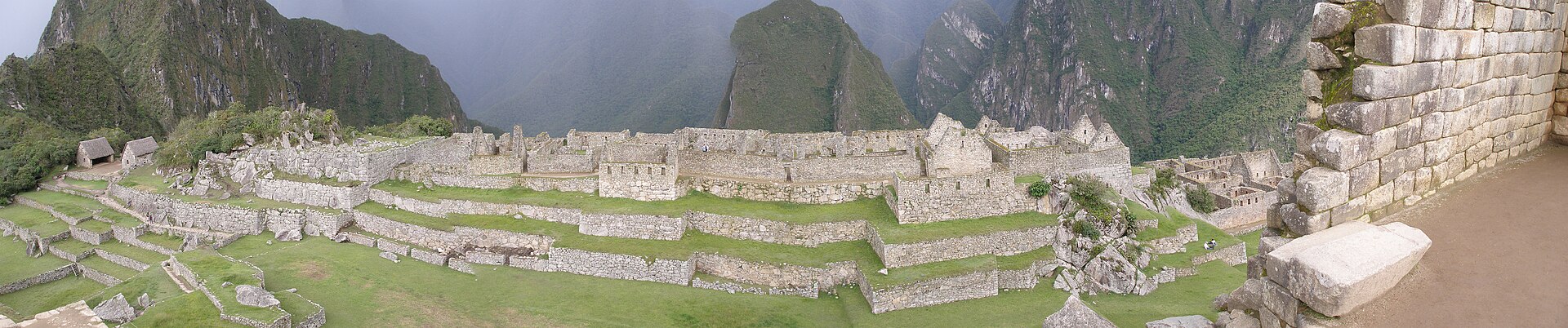
Embedded within a dramatic landscape at the meeting point between the Peruvian Andes and the Amazon Basin, the Historic Sanctuary of Machu Picchu is among the greatest artistic, architectural and land use achievements anywhere and the most significant tangible legacy of the Inca civilization. Recognized for outstanding cultural and natural values, the mixed World Heritage property covers 32,592 hectares of mountain slopes, peaks and valleys surrounding its heart, the spectacular archaeological monument of “ La Ciudadela ” (the Citadel) at more than 2,400 meters above sea level. Built in the fifteenth century Machu Picchu was abandoned when the Inca Empire was conquered by the Spaniards in the sixteenth century.
SOURCE · UNESCO World Heritage Centre
Integrity & Condition
The Historic Sanctuary of Machu Picchu meets the conditions of integrity, as the natural and human-made attributes and values that sustain its Outstanding Universal value are mostly contained within its boundaries. The visual ensemble linking the main archaeological site of the Historic Sanctuary of Machu Picchu with its striking mountain environment remains mostly intact. It is desirable to extend the property to encompass an even broader spectrum of human-land relationships, additional cultural sites, such as Pisac and Ollantaytambo in the Sacred Valley, and a larger part of the Urubamba watershed would contribute to strengthening the overall integrity.
SOURCE · UNESCO World Heritage Centre
Authenticity
Upon the abandonment of the Historic Sanctuary of Machu Picchu at the beginning of the sixteenth century, vegetation growth and isolation ensured the conservation of the architectural attributes of the property. Although the design, materials and structures have suffered slight changes due to the decay of the fabric, the conditions of authenticity have not changed.
SOURCE · UNESCO World Heritage Centre
Later archaeological research and scientific studies
[ edit ] After Bingham's expeditions, state and institutional projects carried out mainly restoration and limited excavations between 1929 and 1971. From the 1970s to the 1990s, a series of targeted excavations and conservation programs recovered mainly Inca artifacts (ceramics, stone tools, and metal objects). They documented disturbed or reworked layers within the site. Between 2014 and 2017, the Archaeological and Interdisciplinary Research Program in the Historic Sanctuary of Machupicchu (PIAISHM) carried out systematic excavations, pollen studies , and architectural analyses that clarified construction phases, recorded offerings, and refined interpretations of its function and population. Radiocarbon dating analyses have refined the site's chronology, indicating that Machu Picchu’s main construction and use fall in the early to mid 15th century, slightly earlier than some traditional documentary chronologies suggest. Between 2017 and 2019, an international team led by Nicola Masini of Italy’s CNR investigated the Principal Plaza using archaeological, remote-sensing, and geophysical data. The study found that the area evolved from a natural drainage basin to a quarry before being reshaped with subsurface drainage. The plaza was likely built in at least two phases, beginning as a smaller sunken plaza (plaza hundida) that was later raised and expanded into the present ceremonial space. [ undue weight? – discuss ]
Preservation
[ edit ] Further information: Historic Sanctuary of Machu Picchu Lagidium peruanum , one of the 70 species of mammals found in the city In 1981, Peru declared an area of 325.92 square kilometers (125.84 sq mi) surrounding Machu Picchu a "Historic Sanctuary". In addition to the ruins, the sanctuary includes a large portion of the adjoining region, rich with the flora and fauna of the Peruvian Yungas and Central Andean wet puna ecoregions . Beyond its historical significance, Machu Picchu houses a diverse range of species. Among them are the Andean fox , puma , vizcacha , spectacled bear , and white-tailed deer . The sanctuary is also a habitat for more than 420 bird species, such as the cock-of-the-rock and the Andean condor . The area hosts over 550 tree species across 74 families, including ferns, gymnosperms, and palms. In 1983, UNESCO designated Machu Picchu a World Heritage Site , describing it as "a masterpiece of art, urbanism, architecture and engineering" and "a unique testimony" of the Inca civilization, with the inscription covering both the archaeological complex and its surrounding landscape.
The modern town of Machu Picchu
[ edit ] Main square of Aguas Calientes , the modern town established near Machu Picchu in the 20th century. Along the Urubamba river, below the ruins, surrounding the train line "street", is the town of Machu Picchu, also known as Aguas Calientes (hot springs), with a post office, a train station, hotels, and other services for the many tourists. The station, called Puente Ruinas (bridge to the ruins), is the end of the line for the tren de turismo (tourist train), which arrives every morning from Cusco and returns every afternoon. There is also a luxury hotel on the mountain, near the ruins. Machu Picchu is officially twinned with Haworth , West Yorkshire , United Kingdom, as well as Fukushima and Ōtama , Japan, Petra , Jordan, Medley , United States, and Tinum , Mexico.