PALMYRA · OVERVIEW
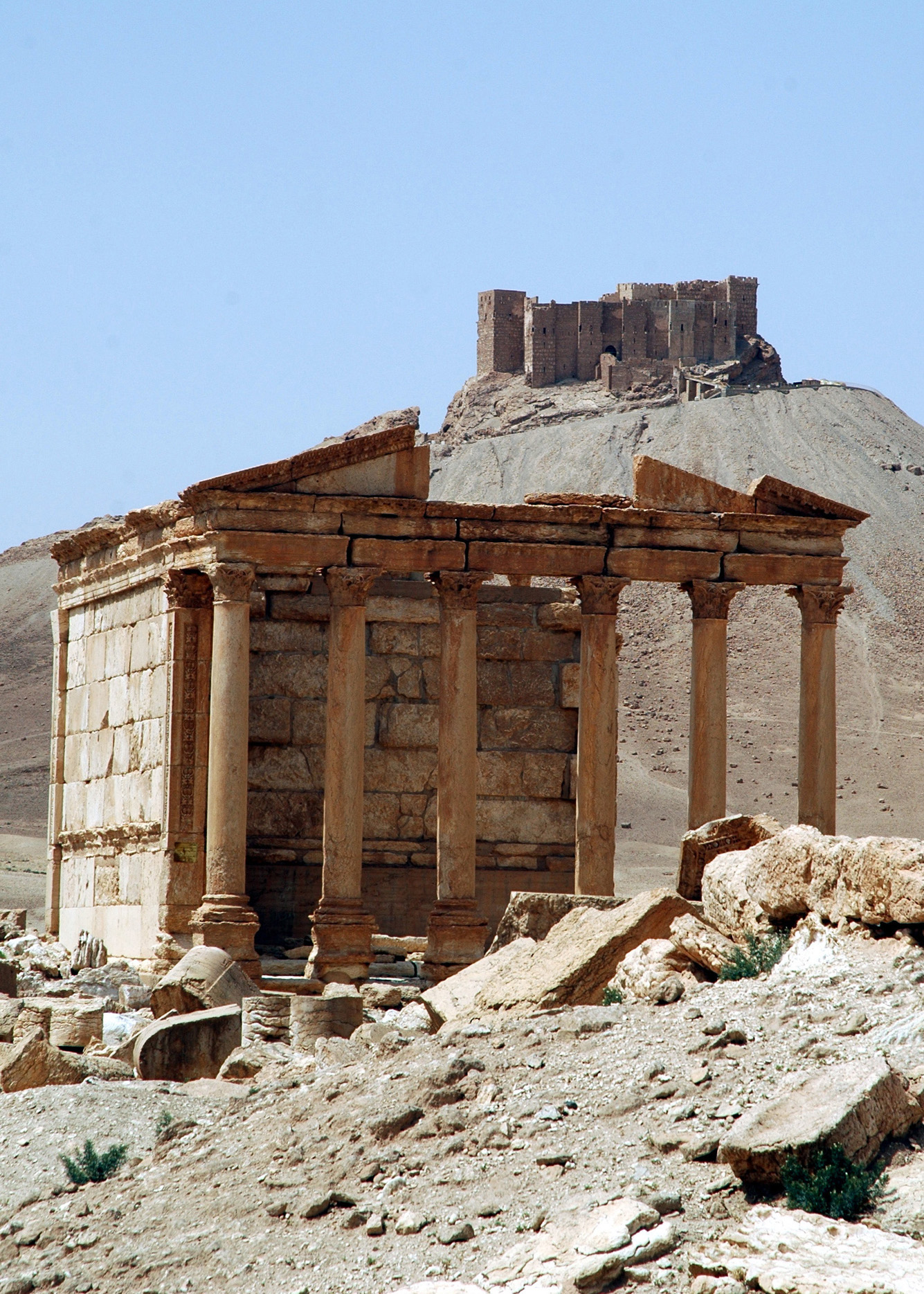
Palmyra is an ancient city in central Syria. It is located in the eastern part of the Levant, and archaeological finds date back to the Neolithic period, and documents first mention the city in the early second millennium BCE. Palmyra changed hands on a number of occasions between different empires before becoming a subject of the Roman Empire in the first century CE.
LOCATION ·
34.55139, 38.26806
Demographic history
[ edit ] The earliest known inhabitants were the Amorites in the early second millennium BC, and by the end of the millennium, Arameans were mentioned as inhabiting the area. Arabs arrived in the city in the late first millennium BC, as evidenced by the presence of Zabdibel on the side of the Seleucids in the battle of Raphia (217 BC). He was mentioned as the commander of "the Arabs and neighbouring tribes to the number of ten thousands"; Zabdibel and his men were not actually identified as Palmyrenes in the texts, but the name "Zabdibel" is a Palmyrene name leading to the conclusion that he hailed from Palmyra. The Arab newcomers were assimilated by the earlier inhabitants, used Palmyrene as a mother tongue, and formed a significant segment of the aristocracy. The classical city also had a Jewish community; Palmyrene inscriptions from the Beit She'arim necropolis in Lower Galilee confirm the burial of Palmyrene Jews. Greeks existence in the city was limited during the Roman period. Occasionally and rarely, members of the Palmyrene families took Greek names while ethnic Greeks were few; the majority of people with Greek names, who did not belong to one of the city's families, were freed slaves. The Palmyrenes seem to have considered the Greeks foreigners, and restricted their settlement in the city. At its height during the reign of Zenobia (around 270), Palmyra had more than 200,000 residents. [ note 4 ] The city's population shrank following the city's integration to the Roman Empire following the rebellion of Zenobia and during the succeeding Umayyad Caliphate , Palmyra was mainly inhabited by the Banu Kalb . Benjamin of Tudela recorded the existence of 2000 Jews in the city during the twelfth century. Palmyra declined after its destruction by Timur in 1400, and was a village of 6,000 inhabitants at the beginning of the 20th century.
History
[ edit ] Efqa Spring , which dried up in 1994 The area has a rich history of human habitation, with evidence of Paleolithic settlements. The site was inhabited during several periods in the Neolithic (10,000–4500 BC). In the area of Tell ez-Zor, an artificial hill in the vicinity of the Efqa Spring, traces of human settlement dates as far back as the Prepottery Neolithic A period, with a three-unit architectural complex dating to the Prepottery Neolithic B period. In the Efqa Spring site, a Neolithic settlement existed, with stone tools dated to 7500 BC.
Research and excavations
[ edit ] The Colonnade The Tetrapylon (destroyed in 2017) Palmyra's first scholarly description appeared in a 1695 paper in the Philosophical Transactions of the Royal Society by William Hallifax followed by a 1696 book by Abednego Seller . In 1751, an expedition led by Robert Wood and James Dawkins studied Palmyra's architecture. French artist and architect Louis-François Cassas conducted an extensive survey of the city's monuments in 1785, publishing over a hundred drawings of Palmyra's civic buildings and tombs. Palmyra was photographed for the first time in 1864 by Louis Vignes. In 1882, the Palmyra Tariff , an inscribed stone slab from AD 137 in Greek and Palmyrene detailing import and export taxation, was discovered by prince Semyon Semyonovich Abamelik-Lazarev in the Tariff Court. It has been described by the historian John F. Matthews as "one of the most important single items of evidence for the economic life of any part of the Roman Empire". In 1901, the slab was gifted by the Ottoman Sultan Abdul Hamid II to the Russian Tsar and is now in the Hermitage Museum in Saint Petersburg . Excavations at Palmyra, 1962, Polish archaeologist Kazimierz Michałowski Palmyra's first excavations were conducted in 1902 by Otto Puchstein and in 1917 by Theodor Wiegand . In 1929, French general director of antiquities of Syria and Lebanon Henri Seyrig began large-scale excavation of the site; interrupted by World War II, it resumed soon after the war's end. Seyrig started with the Temple of Bel in 1929 and between 1939 and 1940 he excavated the Agora. Daniel Schlumberger conducted excavations in the Palmyrene northwest countryside in 1934 and 1935 where he studied different local sanctuaries in the Palmyrene villages. From 1954 to 1956, a Swiss expedition organized by UNESCO excavated the Temple of Baalshamin. Since 1958, the site has been excavated by the Syrian Directorate-General of Antiquities, and Polish expeditions of the Polish Centre of Mediterranean Archaeology University of Warsaw , led consequtively by Kazimierz Michałowski , Anna Sadurska , Michał Gawlikowski and Grzegorz Majcherek . The stratigraphic sounding beneath the Temple of Bel was conducted in 1967