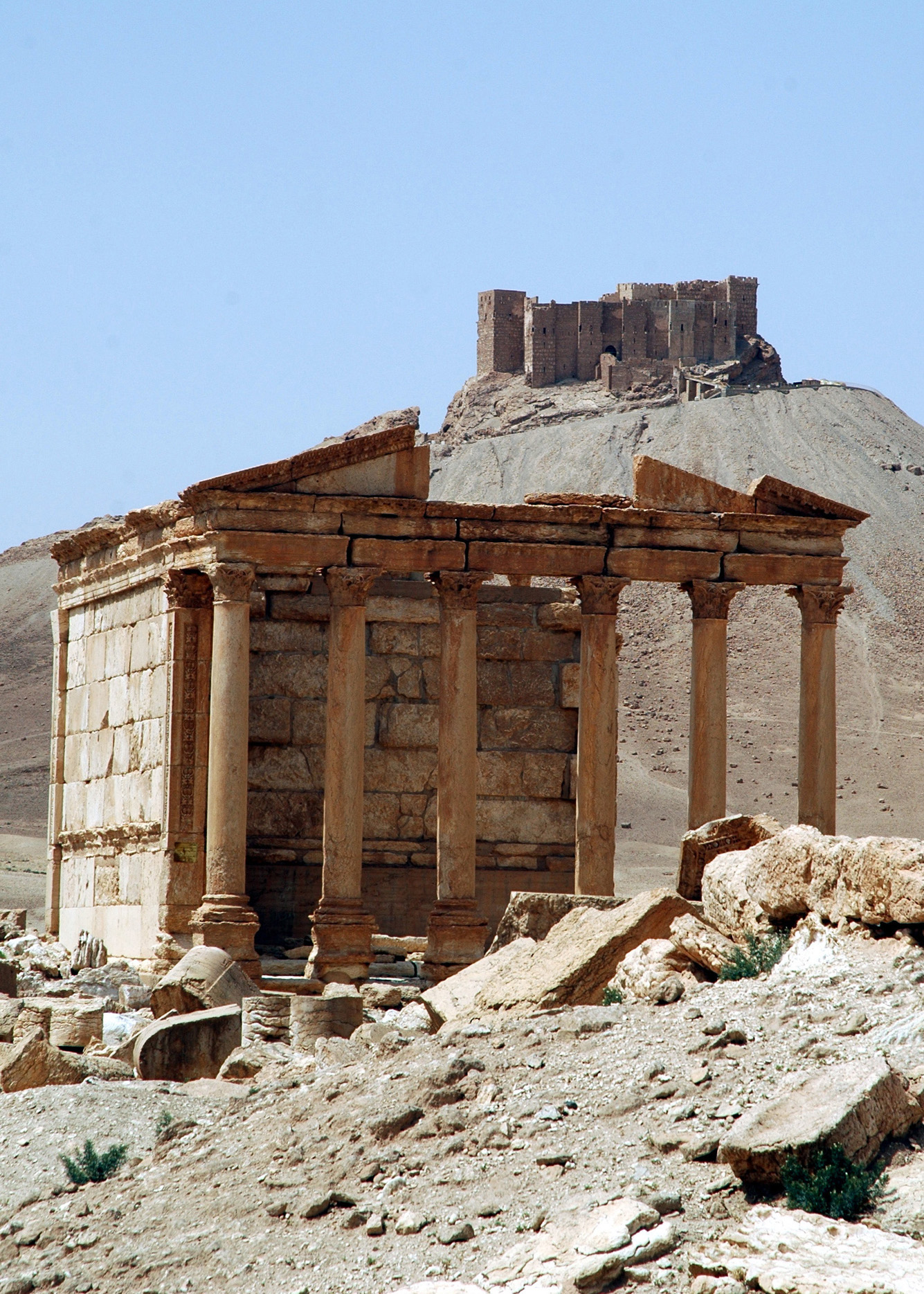
PALMYRA · OVERVIEW
Palmyra is an ancient city in central Syria. It is located in the eastern part of the Levant, and archaeological finds date back to the Neolithic period, and documents first mention the city in the early second millennium BCE. Palmyra changed hands on a number of occasions between different empires before becoming a subject of the Roman Empire in the first century CE.
LOCATION ·
34.55139, 38.26806
World Heritage Record
Inscribed on the UNESCO World Heritage List in 1980. World Heritage criteria: (i)(ii)(iv). Official property area: 1,640 ha.
SOURCE · UNESCO World Heritage Centre
Outstanding Universal Value
An oasis in the Syrian desert, north-east of Damascus, Palmyra contains the monumental ruins of a great city that was one of the most important cultural centres of the ancient world. From the 1st to the 2nd century, the art and architecture of Palmyra, standing at the crossroads of several civilizations, married Graeco-Roman techniques with local traditions and Persian influences. First mentioned in the archives of Mari in the 2nd millennium BC, Palmyra was an established caravan oasis when it came under Roman control in the mid-first century AD as part of the Roman province of Syria.
SOURCE · UNESCO World Heritage Centre
Integrity & Condition
(2009) All the key attributes, including the main colonnaded street, major public buildings and funerary monuments, lie within the boundary. The tower tombs and the citadel are vulnerable to minor earthquakes and lack of conservation. Since the time of inscription, the population of the adjacent town has increased and is encroaching on the archaeological zone.
SOURCE · UNESCO World Heritage Centre
Authenticity
(2009) The key attributes display well their grandeur and splendour. However the setting is vulnerable to the encroachment of the adjacent town that could impact adversely on the way the ruins are perceived as an oasis closely related to their desert surroundings.
SOURCE · UNESCO World Heritage Centre
Protection & Management
(2009) The site was designated a national monument and is now protected by the National Antiquities law 222 as amended in 1999. A buffer zone was established in 2007 but has not yet been submitted to the World Heritage Committee. The regional strategic action plan currently under preparation is expected to provide guidelines to expand and redefine the site as a cultural landscape, with respect to the transitional zones around the archaeological site, the oasis and the city.
SOURCE · UNESCO World Heritage Centre
Restoration
[ edit ] On 21 October 2015, using images gathered and released into the public domain by the Syrian internet advocate Bassel Khartabil between 2005 and 2012, Creative Commons started the New Palmyra project, an online repository of three-dimensional models of the city's monuments. In 2017, two Palmyrene funerary busts restored by the ISCR were sent back to Syria. The restoration of the Lion of Al-lāt took two months and the statue was displayed on 1 October 2017; it will remain in the National Museum of Damascus . Prior to the fall of Al-Assad regime in 2024, the Russians were the main foreign partner involved in the restoration of Palmyra. To gather data that can aid the restoration of the damaged monuments, the site was researched in September 2016 and September 2019 by teams of the RAC IHMC RAS. [ note 14 ] In autumn 2021 Russia and Syria agreed to launch a joint-project to restore the Monumental Arch under the scientific management of the RAC IHMC RAS, and the project was launched in 2022. The teams conducted several studies researching the construction of the arch as a first step in restoring it. Work on the arch was limited to data collection and inventarisation but no restoration took place. In 2022 the Efqa spring site was reopened after being rehabilitated by the Russian-Syrian teams. Following the fall of Al-Assad regime end of 2024 the UNESCO undertook steps to restore the site in cooperation with the Syrian government, ALIPH and the Aga Khan Trust for Culture . As of June 2026, work was limited to surveys and damage assessments.
Research and excavations
[ edit ] The Colonnade The Tetrapylon (destroyed in 2017) Palmyra's first scholarly description appeared in a 1695 paper in the Philosophical Transactions of the Royal Society by William Hallifax followed by a 1696 book by Abednego Seller . In 1751, an expedition led by Robert Wood and James Dawkins studied Palmyra's architecture. French artist and architect Louis-François Cassas conducted an extensive survey of the city's monuments in 1785, publishing over a hundred drawings of Palmyra's civic buildings and tombs. Palmyra was photographed for the first time in 1864 by Louis Vignes. In 1882, the Palmyra Tariff , an inscribed stone slab from AD 137 in Greek and Palmyrene detailing import and export taxation, was discovered by prince Semyon Semyonovich Abamelik-Lazarev in the Tariff Court. It has been described by the historian John F. Matthews as "one of the most important single items of evidence for the economic life of any part of the Roman Empire". In 1901, the slab was gifted by the Ottoman Sultan Abdul Hamid II to the Russian Tsar and is now in the Hermitage Museum in Saint Petersburg . Excavations at Palmyra, 1962, Polish archaeologist Kazimierz Michałowski Palmyra's first excavations were conducted in 1902 by Otto Puchstein and in 1917 by Theodor Wiegand . In 1929, French general director of antiquities of Syria and Lebanon Henri Seyrig began large-scale excavation of the site; interrupted by World War II, it resumed soon after the war's end. Seyrig started with the Temple of Bel in 1929 and between 1939 and 1940 he excavated the Agora. Daniel Schlumberger conducted excavations in the Palmyrene northwest countryside in 1934 and 1935 where he studied different local sanctuaries in the Palmyrene villages. From 1954 to 1956, a Swiss expedition organized by UNESCO excavated the Temple of Baalshamin. Since 1958, the site has been excavated by the Syrian Directorate-General of Antiquities, and Polish expeditions of the Polish Centre of Mediterranean Archaeology University of Warsaw , led consequtively by Kazimierz Michałowski , Anna Sadurska , Michał Gawlikowski and Grzegorz Majcherek . The stratigraphic sounding beneath the Temple of Bel was conducted in 1967