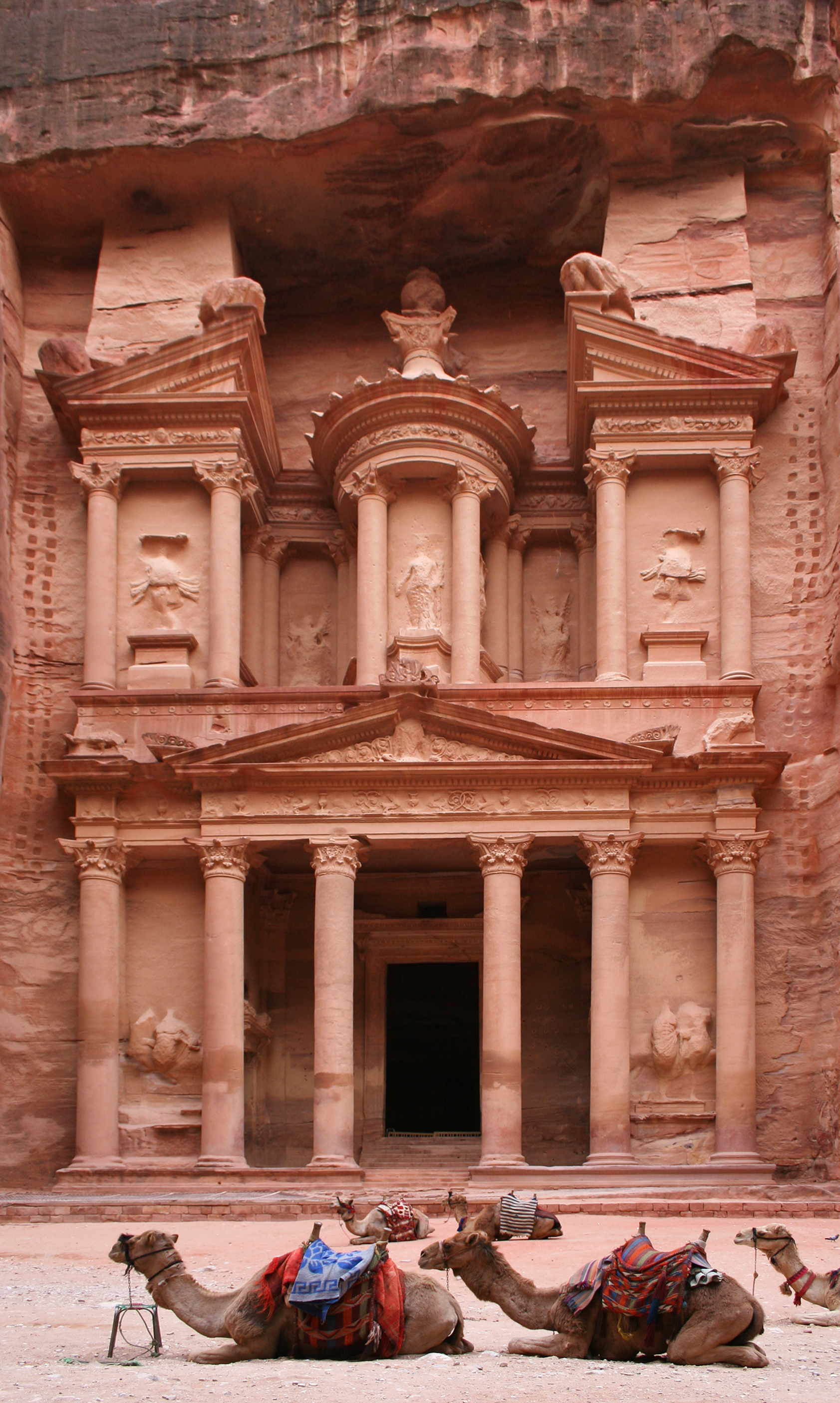
Neolithic
[ edit ] Cliffs near Petra, View over Wadi Arabah By 7000 BC, some of the earliest recorded farmers had settled in Beidha , a Pre-Pottery Neolithic settlement just north of Petra.
Iron Age Edom
[ edit ] The Iron Age lasted between 1200 and 600 BC; in that time, the Petra area was occupied by the Edomites . The configuration of mountains in Petra allowed for a reservoir of water for the Edomites. This made Petra a stopping point for merchants , making it an outstanding area for trade. Some wares that were traded included wines, olive oil, and wood. Initially, the Edomites were accompanied by Nomads who eventually left, but the Edomites stayed and made their mark on Petra before the emergence of the Nabataens. It is said that 10,000 men were thrown off the mountain Umm el-Biyara, but this story has been debated by scholars. The Edomite site excavated at the top of the Umm el-Biyara mountain at Petra was established no earlier than the seventh century BC (Iron II).
Emergence of Petra
[ edit ] The Nabataeans were one among several nomadic Bedouin tribes that roamed the Arabian Desert and moved with their herds to wherever they could find pasture and water. Although the Nabataeans were initially embedded in Aramaic culture, theories about them having Aramean roots are rejected by many modern scholars. Instead, archaeological, religious and linguistic evidence confirm that they are a northern Arabian tribe . Current evidence suggests that the Nabataean name for Petra was Raqēmō, variously spelled in inscriptions as rqmw or rqm . According to the Hebrew Bible , the region was inhabited by the Midianites during the time of Moses , and they were ruled by five kings, one of whom was Rekem (Num. 31:8, Jos. 13:21). Josephus mentions that a city called Petra by the Greeks "ranks highest in the land of the Arabs" and was still called Rekeme by all the Arabs of his time, after its royal founder (Antiquities iv. 7, 1; 4, 7). The Onomasticon of Eusebius also identified Rekem as Petra. Arabic raqama means "to mark, to decorate", so Rekeme could be a Nabataean word referring to the famous carved rock façades. In 1964, workmen clearing rubble away from the cliff at the entrance to the gorge found several funerary inscriptions in Nabatean script. One of them was to a certain Petraios who was born in Raqmu (Rekem) and buried in Garshu ( Jerash ). See also: Sela (Edom) § Confusion with Petra An old theory held that Petra might be identified with a place called sela in the Hebrew Bible . Encyclopædia Britannica (1911) states that the Semitic name of the city, if not Sela, would remain unknown. It nevertheless cautioned that sela simply means "rock" in Hebrew, and thence might not be identified with a city where it occurs in the biblical text in the book of Obadiah. It is possible that the city was part of the nation of Edom. The passage in Diodorus Siculus (xix. 94–97) described the Nabataeans at the time as a nomadic group of people who believed that those who owned possessions could be easily compelled by those who held power, this would drastically change as the centuries went on. This text further describes the expeditions which Antigonus sent against the Na
Roman period
[ edit ] General view Roman bronze coin of Geta showing the Petra temple with statue of Tyche Further information: History of the Romans in Arabia In 106, when Aulus Cornelius Palma Frontonianus was governor of Roman Syria , the part of the Arabian Peninsula under the rule of Petra was absorbed into the Roman Empire as part of Arabia Petraea . The native dynasty came to an end but the city continued to flourish under Roman rule. It was around this time that the Petra Roman Road was built. A century later, in the time of Severus Alexander , when the city was at the height of its splendor, the issue of coinage came to an end. There was no more building of sumptuous tombs, owing apparently to some sudden catastrophe, such as an invasion by the Sasanian Empire . Meanwhile, as Palmyra ( fl. 130–270) grew in importance and attracted the pre-Islamic Arab trade away from Petra, the latter declined. It appears, however, to have lingered on as a religious center. Another Roman road was constructed at the site. Epiphanius of Salamis (c.315–403) writes that in his time a feast was held there on December 25 in honor of the virgin Khaabou and her offspring Dushara . Dushara and al-Uzza were two of the principal deities of the city, which otherwise included many idols from other Nabataean deities such as Allat and Manat. Between 111 and 114, Trajan built the Via Traiana Nova , running from the Syrian border to the Red Sea through Petra. This road followed the old routes of Nabataean caravans. In the shadow of the Pax Romana , this route revived trade between Arabia, Syria, and Mediterranean harbors. In 125 AD, one of Emperor Hadrian 's administrators left marks [ dubious – discuss ] in Petra, pointed out by documents found at the Dead Sea . In 130, Hadrian visited the former Nabataean capital, giving it the name of Hadriānī Petra Metropolis , imprinted on his coins. His visit, however, did not lead to any boom in development and new buildings as it did in Jerash . The province's governor, Sextius Florentinus, erected a monumental mausoleum for his son near the end of the al-Hubta (King's Wall) tombs, which had been generally reserved during the Nabataean period for the royal f