Layout
[ edit ] The narrow passage ( Siq ) that leads to Petra Petra is adjacent to the mountain of Jabal Al-Madbah , in a basin surrounded by mountains forming the eastern flank of the Arabah valley running from the Dead Sea to the Gulf of Aqaba . Excavations have demonstrated that it was the ability of the Nabataeans to control the water supply that led to the rise of the desert city, creating an artificial oasis . The area is visited by flash floods , but archaeological evidence shows that the Nabataeans controlled these floods by the use of dams , cisterns , and water conduits. These innovations stored water for prolonged periods of drought and enabled the city to prosper from its sale. In ancient times, Petra might have been approached from the south on a track leading across the plain of Petra, around Jabal Haroun ("Aaron's Mountain"), the location of the Tomb of Aaron , said to be the burial place of Aaron , brother of Moses . Another approach was possibly from the high plateau to the north. Today, most modern visitors approach the site from the east. The impressive eastern entrance leads steeply down through a dark, narrow gorge, in places only 3–4 m (10–13 ft) wide, called the Siq ("shaft"), a natural geological feature formed from a deep split in the sandstone rocks and serving as a waterway flowing into Wadi Musa .
Hellenistic architecture
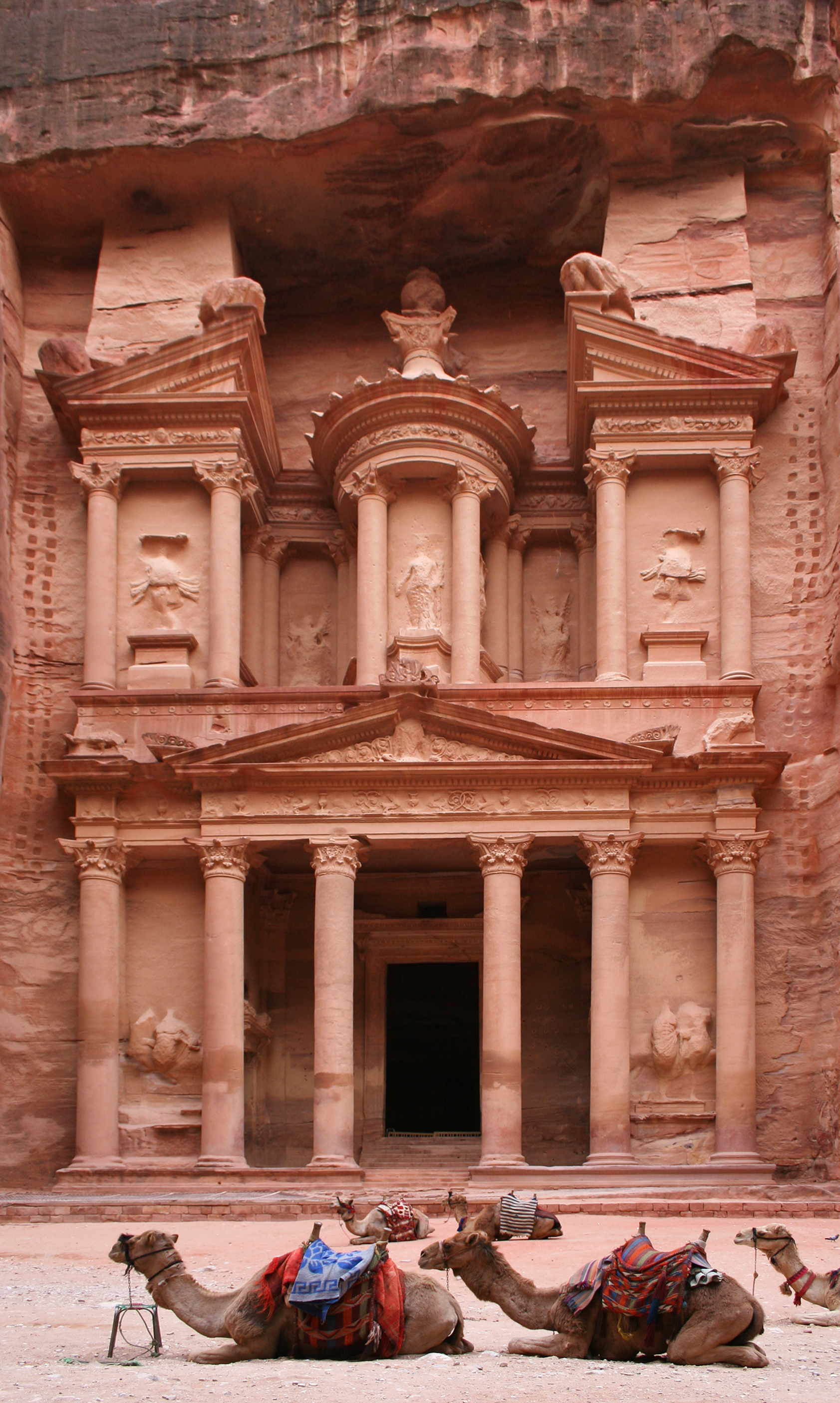
[ edit ] The Hadrian Gate also known as the Temenos Gate Petra is known primarily for its Hellenistic architecture . The facades of the tombs in Petra are commonly rendered in Hellenistic style, reflecting the number of diverse cultures with which the Nabataeans traded, all of which were in turn influenced by Greek culture. Most of these tombs contain small burials niches carved into the stone. Perhaps the best example of the Hellenistic style is seen in the Treasury , which is 24 meters (79 ft) wide and 37 meters (121 ft) tall and refers to the architecture of Alexandria. The facade of the Treasury features a broken pediment with a central tholos inside, and two obelisks appear to form into the rock at the top. Near the bottom of the Treasury are the twin Greek gods Castor and Pollux , who protect travellers on their journeys. Near the top of the Treasury, two victories are seen standing on each side of a female figure on the tholos. This female figure is believed to be the Isis-Tyche, Isis and Tyche being the Egyptian and Greek goddesses, respectively, of good fortune. Another prime example of Hellenistic architecture featured in Petra is its Monastery , which stands at 45 meters (148 ft) tall and 50 meters (160 ft) wide; this is Petra's largest monument and is similarly carved into the rock face. The facade of this again features a broken pediment, similar to the Treasury , as well as another central tholos. The Monastery displays more of a Nabataen touch while at the same time incorporating elements from Greek architecture. Its only source of light is its entrance standing at 8 meters (26 ft) high. There is a large space outside of the Monastery, which is purposefully flattened for worship purposes. Formerly, in the Byzantine period , this was a place for Christian worship, but is now a holy site for pilgrims to visit.