World Heritage Record
Inscribed on the UNESCO World Heritage List in 1985. World Heritage criteria: (i)(iii)(iv). Official property area: 26,171 ha.
SOURCE · UNESCO World Heritage Centre
Outstanding Universal Value
Situated between the Red Sea and the Dead Sea and inhabited since prehistoric times, the rock-cut capital city of the Nabateans, became during Hellenistic and Roman times a major caravan centre for the incense of Arabia, the silks of China and the spices of India, a crossroads between Arabia, Egypt and Syria-Phoenicia. Petra is half-built, half-carved into the rock, and is surrounded by mountains riddled with passages and gorges. An ingenious water management system allowed extensive settlement of an essentially arid area during the Nabataean, Roman and Byzantine periods.
SOURCE · UNESCO World Heritage Centre
Integrity & Condition
All the main freestanding and rock-cut monuments and extensive archaeological remains within the arid landscape of red sandstone cliffs and gorges lie within the boundaries of the property that coincide with the boundaries of the Petra National Park. The monuments are subject to ongoing erosion due to wind and rain, exacerbated in the past by windblown sand due to grazing animals reducing ground cover. The resettlement more than twenty years ago of the Bdul (Bedouin) tribe and their livestock away from their former seasonal dwellings in the Petra basin to a new village at Umm Sayhun was aimed in part at arresting this process.
SOURCE · UNESCO World Heritage Centre
Authenticity
The attributes of temple/tomb monuments, and their location and setting clearly express the Outstanding Universal Value. The natural decay of the sandstone architecture threatens the authenticity of the property in the long-term.
SOURCE · UNESCO World Heritage Centre
Protection & Management
Under Jordanian National law, responsibility for protection of Antiquities sites lies with the Department of Antiquities, a separate entity under the Ministry for Tourism and Antiquities. The property is a protected area within the Petra Archaeological Park managed by the Ministry of Tourism and Antiquities. However responsibility for the overall planning and implementation of infrastructure projects at the site rests largely with the Petra Regional Authority (PRA) - originally the Petra Regional Planning Council (PRPC) - but now expanded to cover the social and economic wellbeing of the communities in the locality.
SOURCE · UNESCO World Heritage Centre
Conservation
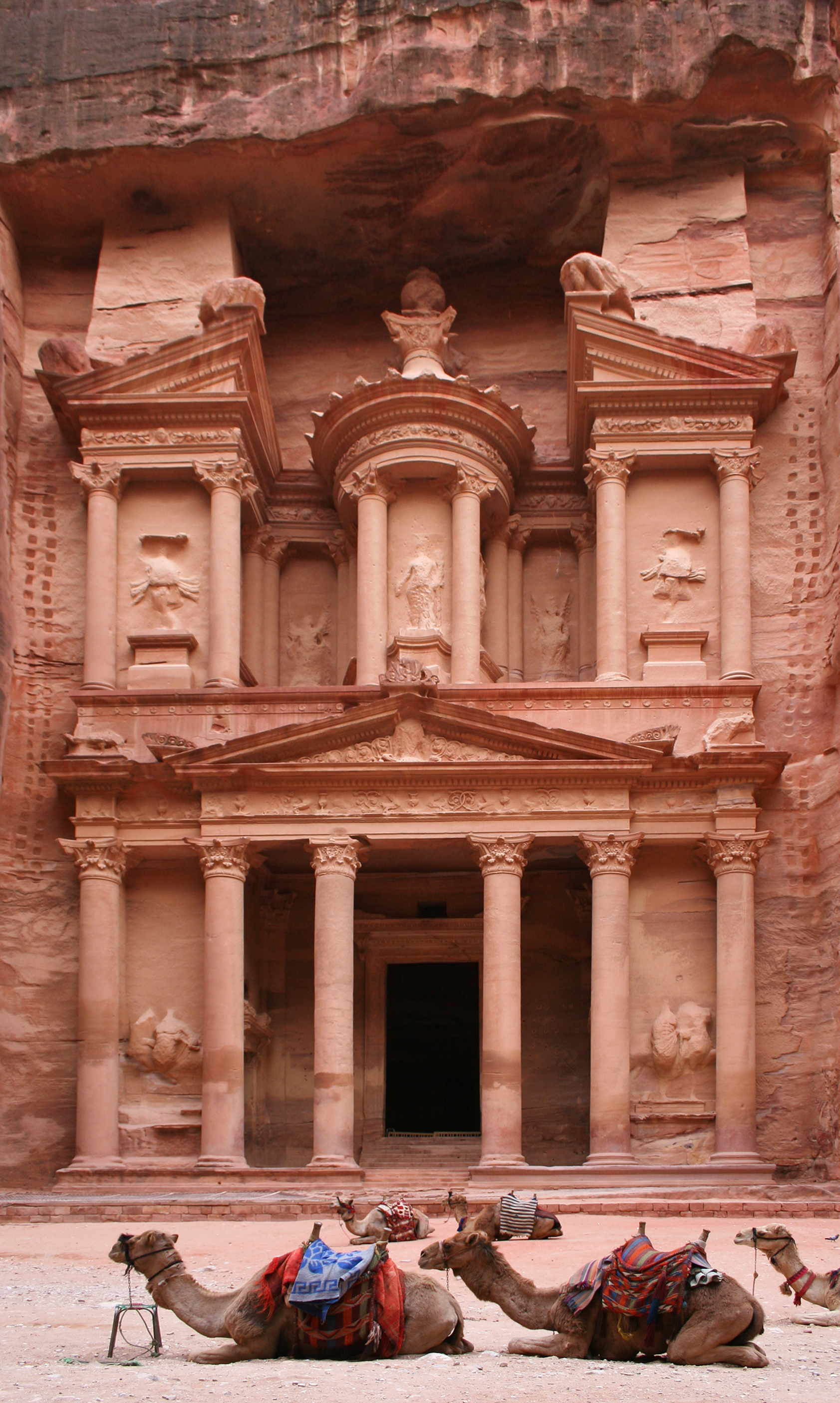
[ edit ] See also: List of World Heritage Sites in Jordan Night event at Al-Khazneh Al-Khazneh , the most popular tourist attraction The Bedul (Petra Bedouin ) were forcibly resettled from their cave dwellings in Petra to Umm Sayhoun/Um Seihun by the Jordanian government in 1985, prior to the UNESCO designation process. They were provided with block-built housing with some infrastructure including in particular a sewage and drainage system. Among the six communities in the Petra Region, Umm Sayhoun is one of the smaller communities. The village of Wadi Musa is the largest in the area, inhabited largely by the Layathnah Bedouin, and is now the closest settlement to the visitor centre, the main entrance via the Siq and the archaeological site generally. Umm Sayhoun gives access to the 'back route' into the site, the Wadi Turkmaniyeh pedestrian route. On December 6, 1985, Petra was designated a World Heritage Site . In a popular poll in 2007, it was also named one of the New 7 Wonders of the World . The Petra Archaeological Park (PAP) became an autonomous legal entity over the management of this site in August 2007. The Urn Tomb The Bedoul belong to one of the Bedouin tribes whose cultural heritage and traditional skills were proclaimed by UNESCO on the Intangible Cultural Heritage List in 2005 and inscribed in 2008. In 2011, following an 11-month project planning phase, the Petra Development and Tourism Region Authority in association with DesignWorkshop and JCP s.r.l published a Strategic Master Plan that guides planned development of the Petra Region. This is intended to guide planned development of the Petra Region in an efficient, balanced and sustainable way over the next 20 years for the benefit of the local population and of Jordan in general. As part of this, a Strategic Plan was developed for Umm Sayhoun and surrounding areas. The process of developing the Strategic Plan considered the area's needs from five points of view: A socio-economic perspective The perspective of Petra Archaeological Park The perspective of Petra's tourism product A land use perspective An environmental perspective The site suffers from a host of threats, including collapse of anc