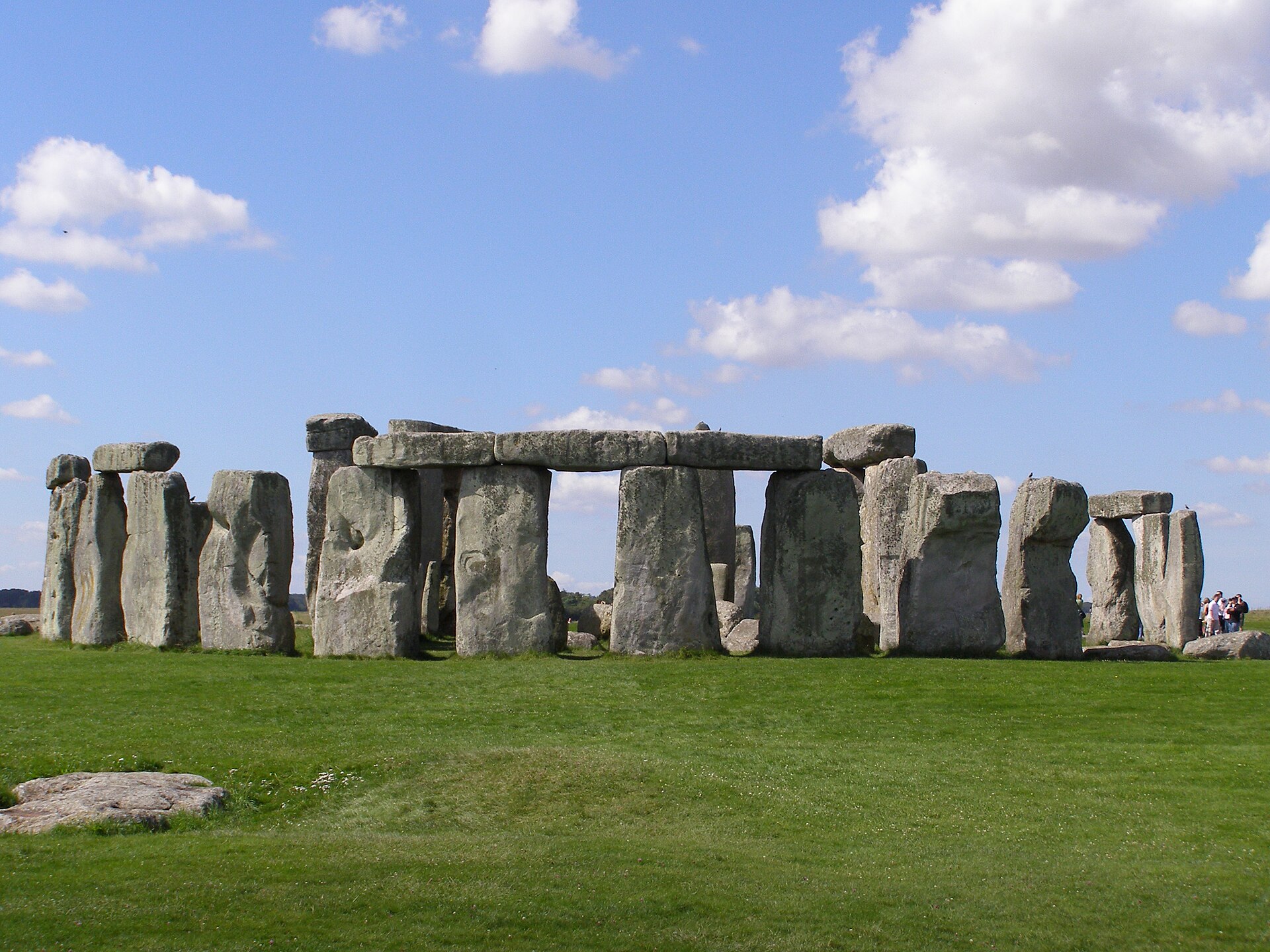
STONEHENGE · OVERVIEW
Stonehenge is a prehistoric megalithic structure on Salisbury Plain in Wiltshire, England, two miles (3 km) west of Amesbury. It consists of an outer ring of vertical sarsen standing stones, each around 13 feet (4.0 m) high, seven feet (2.1 m) wide, and weighing around 25 tons, topped by connecting horizontal lintel stones which are held in place with mortise and tenon joints—a feature unique among contemporary monuments. Inside is a ring of smaller bluestones. Inside these are free-standing trilithons: two bulkier vertical sarsens joined by a single lintel. The whole monument, now in ruins, is aligned towards the sunrise on the summer solstice and sunset on the winter solstice. The stones are set within earthworks in the middle of the densest complex of Neolithic and Bronze Age monuments in England, including several hundred tumuli.
LOCATION ·
51.17889, -1.82611
Early history
[ edit ] Plan of Stonehenge in 2004. After Cleal et al. and Pitts. Italicised numbers in the text refer to the labels on this plan. Trilithon lintels omitted for clarity. Holes that no longer, or never, contained stones are shown as open circles. Stones visible today are shown coloured. Mike Parker Pearson , leader of the Stonehenge Riverside Project based around Durrington Walls , noted that Stonehenge appears to have been associated with burial from the earliest period of its existence: Stonehenge was a place of burial from its beginning to its zenith in the mid third [ sic ] millennium B.C. The cremation burial dating to Stonehenge's sarsen stones phase is probably just one of many from this later period of the monument's use and demonstrates that it was still very much a domain of the dead. Stonehenge evolved in several construction phases spanning at least 1500 years. There is evidence of large-scale construction on and around the monument, perhaps extending the landscape's time frame to 6500 years. Dating and understanding the various phases of activity are complicated by disturbance of the natural chalk by periglacial effects and animal burrowing, poor quality early excavation records, and a lack of accurate, scientifically verified dates. The modern phasing most generally agreed to by archaeologists is detailed below. Features mentioned in the text are numbered and shown on the plan, right.
Function and construction
[ edit ] Directions of sunrise and sunset at Stonehenge on the 21st of each month, where 𝜙 is its latitude and 𝜀 is Earth's axial tilt Main article: Theories about Stonehenge See also: Archaeoastronomy and Stonehenge Stonehenge was produced by a culture that left no written records. Many aspects of Stonehenge, such as how it was built and for what purposes it was used, remain subject to debate. A number of myths surround the stones. The site, specifically the great trilithon, the encompassing horseshoe arrangement of the five central trilithons, the heel stone, and the embanked avenue, are aligned to the sunset of the winter solstice and the opposing sunrise of the summer solstice. A natural landform at the monument's location followed this line, and may have inspired its construction. It has been conjectured that the design of the monument included a celestial observatory function, which might allow prediction of eclipse, solstice, equinox and other celestial events important to the builders' belief system. The excavated remains of culled animal bones suggest that people may have gathered at the site for the winter rather than the summer. There is little or no direct evidence revealing the construction techniques used by the Stonehenge builders. Over the years, various authors have suggested that supernatural or anachronistic methods were used, often asserting that the stones could not have been moved otherwise due to their massive size. However, conventional techniques, using Neolithic technology as basic as shear legs , have been demonstrably effective at moving and placing stones of a similar size. The most common theory of how prehistoric people moved megaliths has them creating a track of logs along which the large stones were rolled. Another megalith transport theory involves the use of a type of sleigh running on a track greased with animal fat. An experiment with a sleigh carrying a 40-ton slab of stone was successfully conducted near Stonehenge in 1995; a team of more than 100 workers managed to push and pull the slab along the 18-mile (29 km) journey from the Marlborough Downs . Proposed functions for the site include usage as an astronomical observat
Origin of sarsens, bluestones and other modern developments
[ edit ] Map of Stonehenge monument and detailed plan of individual numbered sarsen stones, bluestones and Altar Stone In July 2020, a study led by David Nash of the University of Brighton concluded that the large sarsen stones were "a direct chemical match" to those found at West Woods near Marlborough, Wiltshire , some 15 miles (25 km) north of Stonehenge. A core sample, originally extracted in 1958, had recently been returned. First, the fifty-two sarsens were analysed using methods including x-ray fluorescence spectrometry to determine their chemical composition, which revealed they were mostly similar. The core was then destructively analysed and compared with stone samples from various locations in southern Britain. Fifty of the fifty-two megaliths were found to match sarsens in West Woods, thereby identifying the probable origin of the stones. During 2017 and 2018, excavations by professor Parker Pearson's team at Waun Mawn , a large stone circle site in the Preseli Hills , suggested that the site had originally housed a 110-metre (360 ft) diameter stone circle of the same size as Stonehenge's original bluestone circle, also orientated towards the midsummer solstice. The circle at Waun Mawn also contained a hole from one stone which had a distinctive pentagonal shape, very closely matching the one pentagonal stone at Stonehenge (stonehole 91 at Waun Mawn and stone 62 at Stonehenge). Soil dating of the sediments within the revealed stone holes, via optically stimulated luminescence (OSL), suggested the absent stones at Waun Mawn had been erected around 3400–3200 BC, and removed around 300–400 years later, a date consistent with theories that the same stones were moved and used at Stonehenge, before later being reorganised into their present locations and supplemented with local sarsens as was already understood. Human activity at Waun Mawn ceased around the same time which has suggested that some people may have migrated to Stonehenge. It has also been suggested that stones from other sources may have been added to Stonehenge, perhaps from other dismantled circles in the region. Further work in 2021 by Parker Pearson's team concluded that the Waun Mawn cir