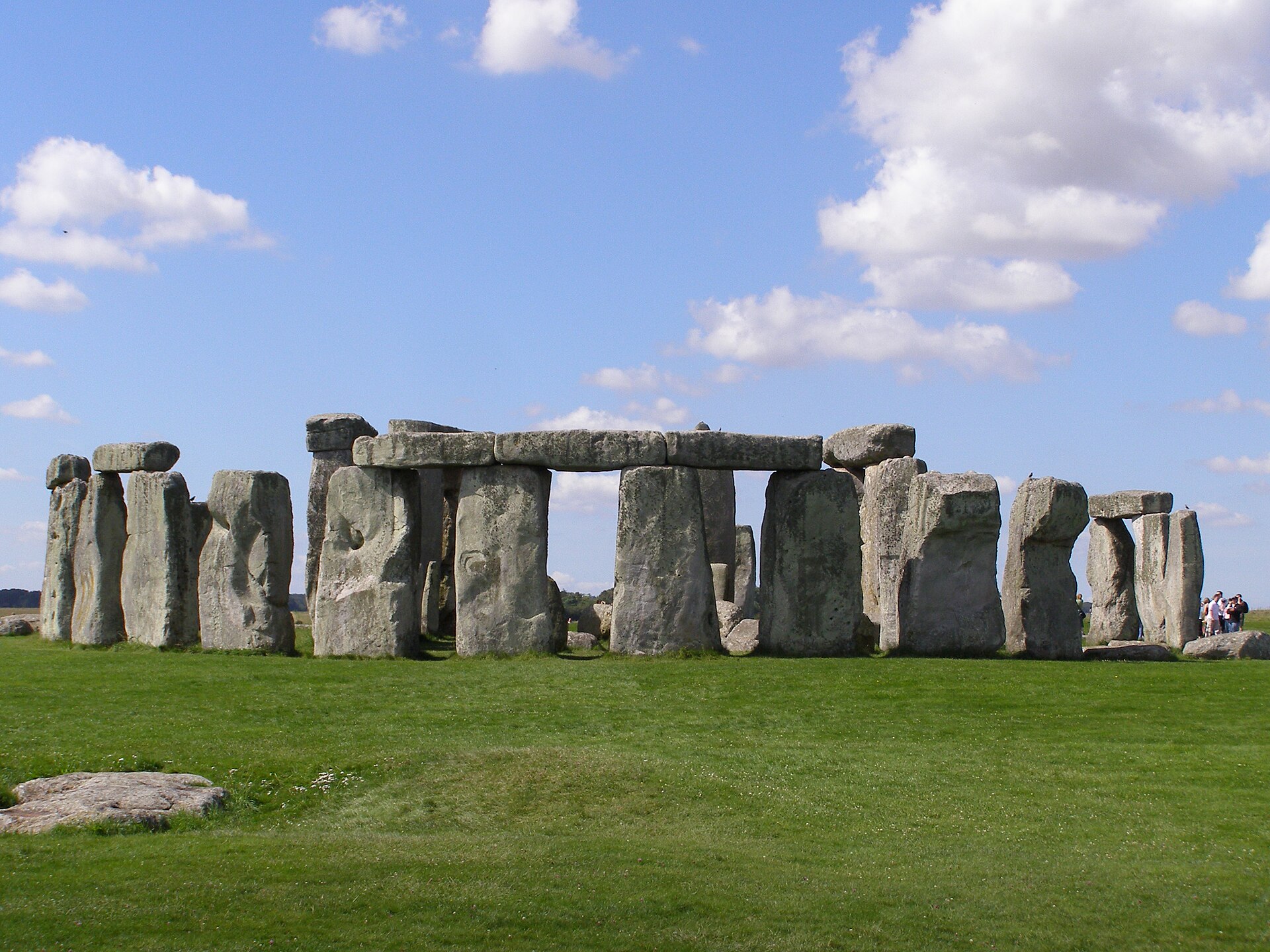
STONEHENGE · OVERVIEW
Stonehenge is a prehistoric megalithic structure on Salisbury Plain in Wiltshire, England, two miles (3 km) west of Amesbury. It consists of an outer ring of vertical sarsen standing stones, each around 13 feet (4.0 m) high, seven feet (2.1 m) wide, and weighing around 25 tons, topped by connecting horizontal lintel stones which are held in place with mortise and tenon joints—a feature unique among contemporary monuments. Inside is a ring of smaller bluestones. Inside these are free-standing trilithons: two bulkier vertical sarsens joined by a single lintel. The whole monument, now in ruins, is aligned towards the sunrise on the summer solstice and sunset on the winter solstice. The stones are set within earthworks in the middle of the densest complex of Neolithic and Bronze Age monuments in England, including several hundred tumuli.
LOCATION ·
51.17889, -1.82611
Stonehenge 1 ( c. 3100 BC )
[ edit ] Stonehenge 1. After Cleal et al. The first monument consisted of a circular bank and ditch enclosure made of Late Cretaceous ( Santonian Age) Seaford chalk , measuring about 360 feet (110 m) in diameter, with a large entrance to the north east and a smaller one to the south. It stood in open grassland on a slightly sloping spot. The builders placed the bones of deer and oxen in the bottom of the ditch, as well as some worked flint tools. The bones were considerably older than the antler picks used to dig the ditch, and the people who buried them had looked after them for some time prior to burial. The ditch was continuous but had been dug in sections, like the ditches of the earlier causewayed enclosures in the area. The chalk dug from the ditch was piled up to form the bank. This first stage is dated to around 3100 BC, after which the ditch began to silt up naturally. Within the outer edge of the enclosed area is a circle of 56 pits, each about 3.3 feet (1 m) in diameter, known as the Aubrey holes after John Aubrey , the 17th-century antiquarian who was thought to have first identified them. These pits and the bank and ditch together are known as the Palisade or Gate Ditch. The pits may have contained standing timbers creating a timber circle , although there is no excavated evidence of them. A recent excavation has suggested that the Aubrey Holes may have originally been used to erect a bluestone circle. If this were the case, it would advance the earliest known stone structure at the monument by some 500 years. In 2013, a team of archaeologists, led by Parker Pearson, excavated more than 50,000 cremated bone fragments, from 63 individuals, buried at Stonehenge. These remains were originally buried individually in the Aubrey holes, but were exhumed in 1920 during an excavation by William Hawley , who considered them unimportant and in 1935 re-buried them together in one hole, Aubrey Hole 7. Physical and chemical analysis of the remains has shown that the cremated were almost equally men and women, and included some children. There is evidence that the underlying chalk beneath the graves was crushed by substantial weight, so the team concluded that the
Stonehenge 2 ( c. 2900 BC )
[ edit ] The second phase of construction occurred approximately between 2900 and 2600 BC. The number of postholes dating to the early third millennium BC suggests that some form of timber structure was built within the enclosure during this period. Further standing timbers were placed at the northeast entrance, and a parallel alignment of posts ran inwards from the southern entrance. The postholes are smaller than the Aubrey Holes, being only around 16 inches (0.4 m) in diameter, and are much less regularly spaced. The bank was purposely reduced in height, and the ditch continued to silt up. At least twenty-five of the Aubrey Holes are known to have contained later, intrusive, cremation burials dating to the two centuries after the monument's inception. It seems that whatever the holes' original function was, it became a funerary one during Phase two. Thirty further cremations were placed in the enclosure's ditch and at other points within the monument, mostly in the eastern half. Stonehenge is therefore interpreted as functioning as an enclosed cremation cemetery at this time, the earliest known cremation cemetery in the British Isles. Fragments of unburnt human bone have also been found in the ditch-fill. Dating evidence is provided by the late Neolithic grooved ware pottery found in association with the features of this phase.
Stonehenge 3 I ( c. 2600 BC )
[ edit ] Graffiti on the sarsen stones include ancient carvings of a dagger and an axe. Archaeological excavation has indicated that around 2600 BC, the builders abandoned timber in favour of stone and dug two concentric arrays of holes (the Q and R Holes ) in the centre of the site. These stone sockets are only partly known (hence, on present evidence, are sometimes described as forming 'crescents'); however, they could be the remains of a double ring. Again, there is little firm dating evidence for this phase. The holes held up to 80 standing stones (shown blue on the plan), only 43 of which can be traced today. It is generally accepted that the bluestones (some of which are made of dolerite , an igneous rock), were transported by the builders from the Preseli Hills , 150 miles (240 km) away in modern-day Pembrokeshire in Wales. Another theory is that they were brought much nearer to the site as glacial erratics by the Irish Sea Glacier although there is no evidence of glacial deposition within southern central England. A 2019 publication announced that evidence of Megalithic quarrying had been found at quarries in Wales identified as a source of Stonehenge's bluestone, indicating that the bluestone was quarried by human agency and not transported by glacial action. The long-distance human transport theory was bolstered in 2011 by the discovery of a megalithic bluestone quarry at Craig Rhos-y-felin , near Crymych in Pembrokeshire, which is the most probable source of some of the stones. Other standing stones may well have been small sarsens (sandstone), used later as lintels. The stones, which weighed about two tons, could have been moved by lifting and carrying them on rows of poles and rectangular frameworks of poles, as recorded in China, Japan, and India. It is not known whether the stones were taken directly from their quarries to Salisbury Plain or were the result of the removal of a venerated stone circle from Preseli to Salisbury Plain to "merge two sacred centres into one, to unify two politically separate regions, or to legitimise the ancestral identity of migrants moving from one region to another". Evidence of a 110-metre (360 ft) stone circle at W
Stonehenge 3 II (2600 BC to 2400 BC)
[ edit ] Sketch showing the tongue and groove and mortise and tenon joints used in the outer Sarsen circle Plan of the central stone structure today; after Johnson 2008 During the next major phase of activity, 30 enormous Oligocene – Miocene sarsen stones (shown grey on the plan) were brought to the site. They came from a quarry around 16 miles (26 km) north of Stonehenge, in West Woods , Wiltshire . The stones were dressed and fashioned with mortise and tenon joints before 30 sarsens were erected in a circle of standing stones approximately 98 feet (30 m) in diameter, with a ring of 30 lintel stones resting on top. The lintels were fitted to one another using tongue and groove joints – a woodworking method, again. Each standing stone was around 13.5 feet (4.11 m) high, 7.0 feet (2.13 m) wide, and 3.5 feet (1.06 m) deep, weighing around 26 tons. Each had clearly been worked with the final visual effect in mind: The orthostats widen slightly towards the top to keep their perspective constant when viewed from the ground, while the lintel stones curve slightly to continue the circular appearance of the earlier monument. The inward-facing surfaces of the stones are smoother and more finely worked than the outer surfaces. The average thickness of the stones is 3.6 feet (1.1 m) and the average distance between them is 3.3 feet (1 m). A total of 75 stones would have been needed to complete the circle (60 stones) and the trilithon horseshoe (15 stones). It was thought the ring might have been left incomplete, but an exceptionally dry summer in 2013 revealed patches of parched grass which may correspond to the location of missing sarsens. The lintel stones are each around 10 feet (3.2 m) long, 3.3 feet (1 m) wide and 2.6 feet (0.8 m) thick. The tops of the lintels are 16 feet (4.9 m) above the ground. Within this circle stood five trilithons of dressed sarsen stone arranged in a horseshoe shape 45 feet (13.7 m) across, with its open end facing northeast. These huge stones, ten uprights and five lintels, weigh up to 50 tons each. They were linked using complex jointing. They are arranged symmetrically. The smallest pair of trilithons were around 20 feet (6 m) tall, the ne