TAJ MAHAL · OVERVIEW
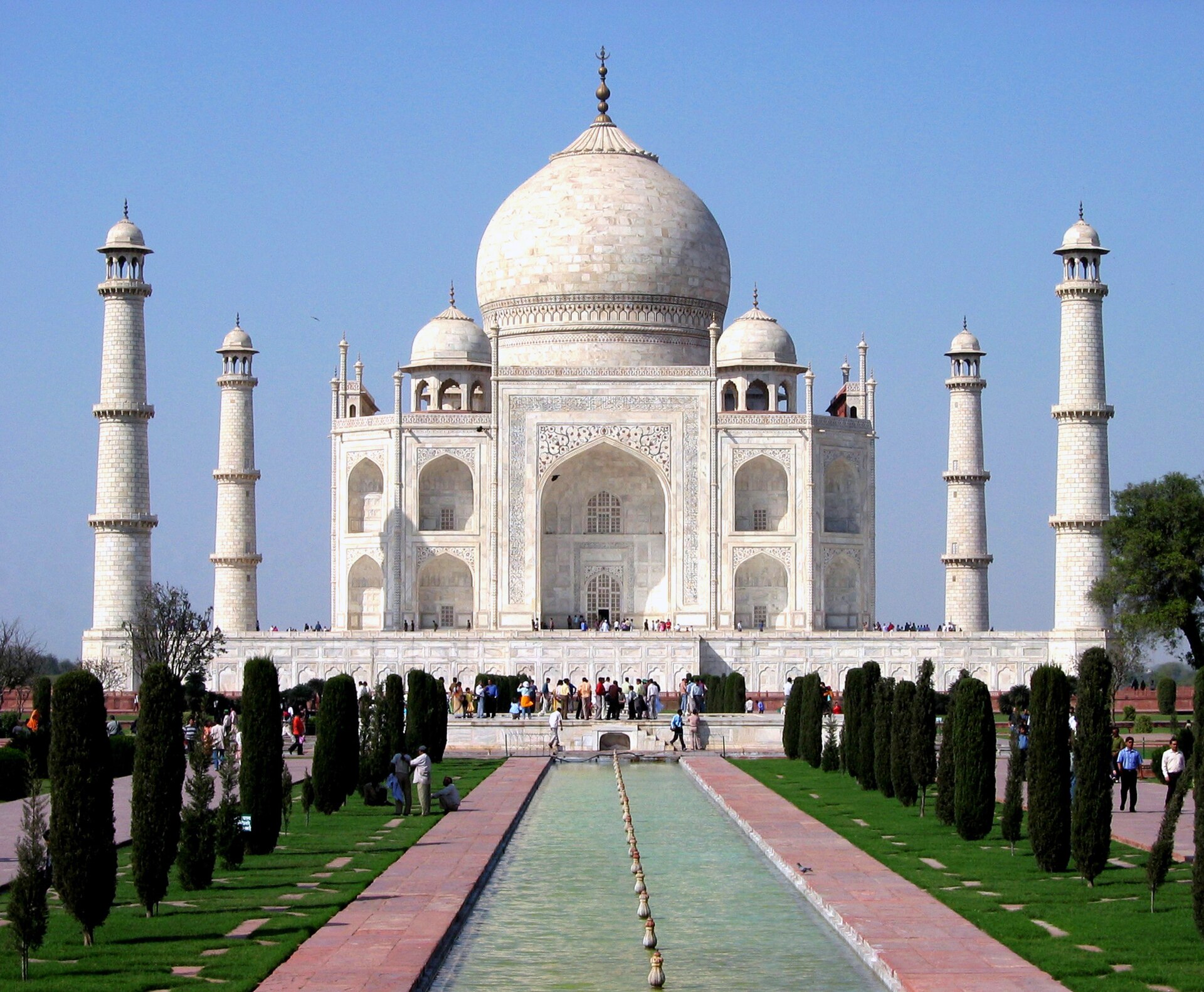
The Taj Mahal is an ivory-white marble mausoleum on the right bank of the river Yamuna in Agra, Uttar Pradesh, India. It was commissioned in 1631 by the fifth Mughal emperor, Shah Jahan, to house the tomb of his late wife, Mumtaz Mahal; it also houses the tomb of Shah Jahan himself. The tomb is the centrepiece of a 17-hectare (42-acre) complex, which includes a mosque and a guest house, and is set in formal gardens bounded on three sides by a crenellated wall.
LOCATION ·
27.17500, 78.04190
Construction
[ edit ] Animation showing the construction of the Taj Mahal The land on which the Taj Mahal is situated was present to the south of the walled city of Agra which was given to Shah Jahan by Raja Jai Singh I in exchange for a large palace in the centre of Agra. The building was commissioned in 1631, and construction commenced in 1632. An area of roughly 1.2 hectares (3 acres) was excavated, filled with dirt to reduce seepage, and levelled at 50 metres (160 ft) above the riverbank level. In the tomb area, piles were dug and filled with lime and stone to form the footings of the tomb. The platform above the ground was constructed of brick and mortar . The tomb complex was built mainly using brick and lime mortar. The external surface of the main tomb building and the interior of the main cenotaph chamber is veneered with white marble. The other interior surfaces and other accessory buildings are lined with red sandstone coated with a red octet for protection, excluding the exterior surfaces of domes. The white marble came from Makrana in Rajasthan, while the red sandstone was quarried from Fatehpur Sikri in Uttar Pradesh. Many precious and semi-precious stones, used for decoration, were imported from across the world, including jade and crystal from China, turquoise from Tibet , Lapis lazuli from Afghanistan , sapphire from Sri Lanka and carnelian from Arabia . In all, 28 types of precious and semi-precious stone were inlaid into the white marble. It is believed that more than 20,000 artisans, labourers, painters and others were involved in the construction of the building. Specialist sculptors from Bukhara , calligraphers from Syria and Persia , designers from southern India , stone cutters from Baluchistan and Italian artisans were employed. Workmen constructed a colossal brick scaffold that mirrored the tomb rather than wooden scaffolds. A 15 km (9.3 mi) long earthern ramp was built to transport marble and materials to the construction site, hauled on specially constructed wagons by teams of oxen and elephants. An elaborate post-and-beam pulley system was used to raise the blocks into the desired position. Water was drawn from the river by a series of an animal-
Etymology
[ edit ] The name "Taj Mahal" is of Urdu origin, and believed to be derived from Arabic and Persian , with the words tāj mahall meaning "crown" ( tāj ) "palace" ( mahall ). An alternative derivation of "taj" is that it was a corruption of the second syllable of "Mumtaz". Abdul Hamid Lahori , in his 1636 book Padshahnama , refers to the Taj Mahal as rauza -i munawwara ( Perso-Arabic : روضه منواره , rawdah-i munawwarah ), meaning the illumined or illustrious tomb.
Inspiration
[ edit ] Shah Jahan , 17th century painting Artistic depiction of Mumtaz Mahal The Taj Mahal was commissioned by Shah Jahan in 1631, to be built in the memory of his wife Mumtaz Mahal , who died on 17 June that year while giving birth to their 14th child, Gauhara Begum . Construction started in 1632, and the mausoleum was completed in 1648, while the surrounding buildings and garden were finished five years later. The imperial court documenting Shah Jahan's grief after the death of Mumtaz Mahal illustrates the love story held as the inspiration for the Taj Mahal. According to contemporary historians Muhammad Amin Qazvini, Abdul Hamid Lahori and Muhammad Saleh Kamboh , Shah Jahan did not show the same level of affection for others as he had shown Mumtaz while she was alive. After her death, he avoided royal affairs for a week due to his grief and gave up listening to music and lavish dressing for two years. Shah Jahan was enamoured by the beauty of the land at the south side of Agra on which a mansion belonging to Raja Jai Singh I stood. He chose the place for the construction of Mumtaz's tomb after which Jai Singh agreed to give it to emperor Shah Jahan in exchange for a large palace in the centre of Agra.
Architecture and design
[ edit ] Main article: Origins and architecture of the Taj Mahal The Taj Mahal complex is situated on a platform on the banks of the Yamuna River. The Taj Mahal incorporates and expands on design traditions of Indo-Islamic and Mughal architecture . Inspirations for the building came from Timurid and Mughal buildings including the Gur-e Amir in Samarkand (the tomb of Timur , progenitor of the Mughal dynasty) and Humayun's Tomb in Delhi which inspired the Charbagh gardens and hasht-behesht plan of the site. The building complex employs symmetrical constructions with the usage of various shapes and symbols. While the mausoleum is constructed of white marble inlaid with semi-precious stones , red sandstone was used for other buildings in the complex similar to the Mughal era buildings of the time. The entire complex sits on a platform measuring 300 metres (980 ft) in length and 8.7 metres (28.5 ft) in height on the banks of the Yamuna river . The platform is built with varying patterns of dark and light colored sandstone.