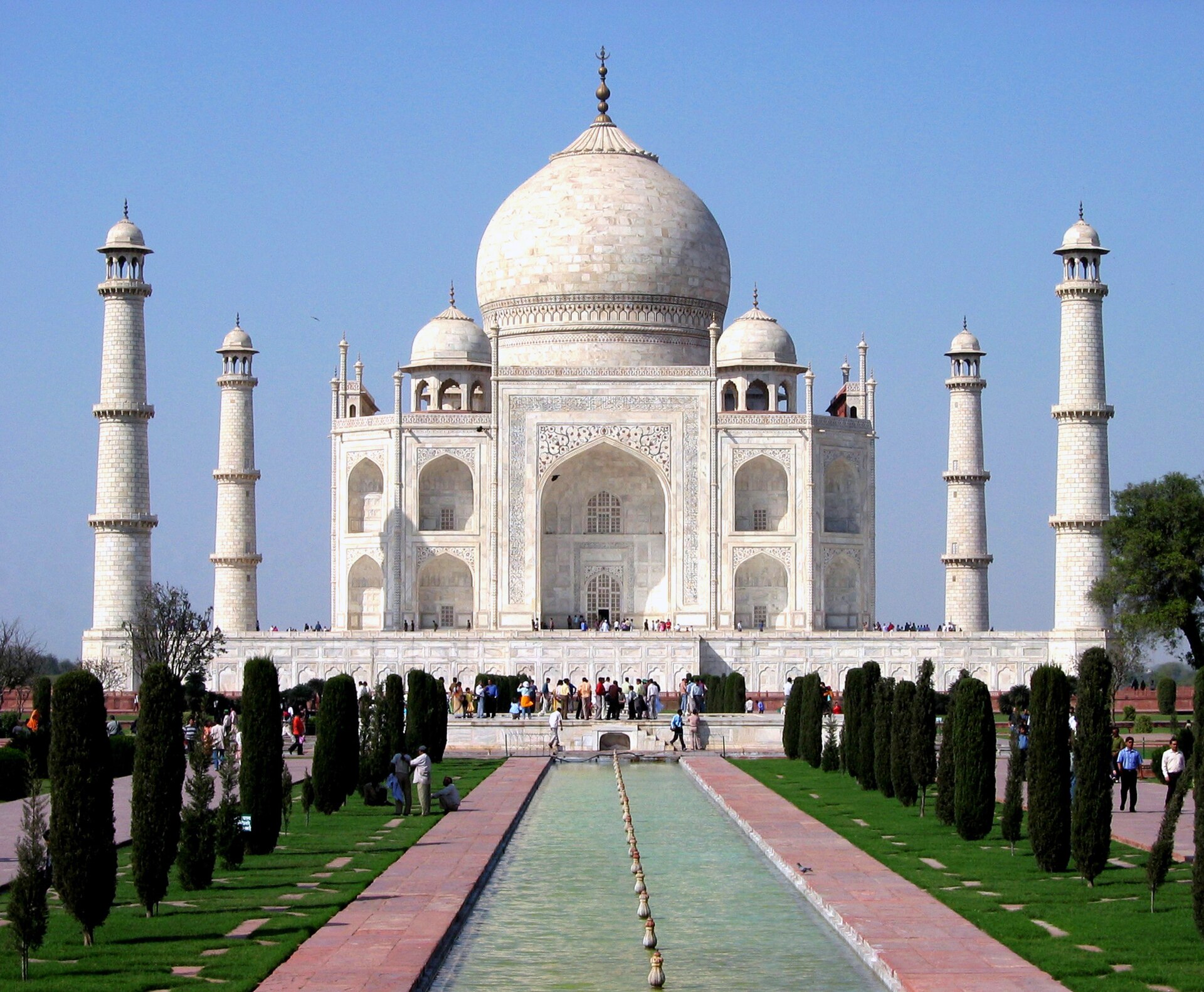
TAJ MAHAL · OVERVIEW
The Taj Mahal is an ivory-white marble mausoleum on the right bank of the river Yamuna in Agra, Uttar Pradesh, India. It was commissioned in 1631 by the fifth Mughal emperor, Shah Jahan, to house the tomb of his late wife, Mumtaz Mahal; it also houses the tomb of Shah Jahan himself. The tomb is the centrepiece of a 17-hectare (42-acre) complex, which includes a mosque and a guest house, and is set in formal gardens bounded on three sides by a crenellated wall.
LOCATION ·
27.17500, 78.04190
World Heritage Record
Inscribed on the UNESCO World Heritage List in 1983. World Heritage criteria: (i).
SOURCE · UNESCO World Heritage Centre
Outstanding Universal Value
The Taj Mahal is located on the right bank of the Yamuna River in a vast Mughal garden that encompasses nearly 17 hectares, in the Agra District in Uttar Pradesh. It was built by Mughal Emperor Shah Jahan in memory of his wife Mumtaz Mahal with construction starting in 1632 AD and completed in 1648 AD, with the mosque, the guest house and the main gateway on the south, the outer courtyard and its cloisters were added subsequently and completed in 1653 AD. The existence of several historical and Quaranic inscriptions in Arabic script have facilitated setting the chronology of Taj Mahal.
SOURCE · UNESCO World Heritage Centre
Integrity & Condition
Integrity is maintained in the intactness of tomb, mosque, guest house, main gate and the whole Taj Mahal complex. The physical fabric is in good condition and structural stability, nature of foundation, verticality of the minarets and other constructional aspects of Taj Mahal have been studied and continue to be monitored. To control the impact of deterioration due for atmospheric pollutants, an air control monitoring station is installed to constantly monitor air quality and control decay factors as they arise.
SOURCE · UNESCO World Heritage Centre
Authenticity
The tomb, mosque, guest house, main gate and the overall Taj Mahal complex have maintained the conditions of authenticity at the time of inscription. Although an important amount of repairs and conservation works have been carried out right from the British period in India these have not compromised to the original qualities of the buildings.
SOURCE · UNESCO World Heritage Centre
Protection & Management
The management of Taj Mahal complex is carried out by the Archaeological Survey of India and the legal protection of the monument and the control over the regulated area around the monument is through the various legislative and regulatory frameworks that have been established, including the Ancient Monument and Archaeological Sites and Remains Act 1958 and Rules 1959 Ancient Monuments and Archaeological Sites and Remains (Amendment and Validation); which is adequate to the overall administration of the property and buffer areas. Additional supplementary laws ensure the protection of the property in terms of development in the surroundings. An area of 10,400 sq km around the Taj Mahal is defined to protect the monument from pollution.
SOURCE · UNESCO World Heritage Centre
Tourism
[ edit ] Visitors at the Taj Mahal The Taj Mahal is a major tourist attraction and attracts a large number of domestic and foreign visitors. About five million visitors visited Taj Mahal in the financial year 2022–23. A three-tier pricing system is in place, with a significantly lower entrance fee for Indian citizens and more expensive ones for foreigners. As of 2024 [ update ] , the fee for Indian citizens was ₹ 50, for citizens of SAARC and BIMSTEC countries, it was ₹ 540 and for other foreign tourists, it was ₹ 1,100. Visitors are allowed through three gates and, as polluting vehicles are not allowed near the complex, tourists must either walk or take electric buses from the designated parking areas. The complex is open on all days except on Fridays, from one hour before sunrise to 45 minutes before sunset. The complex is open for limited night viewing on the day of the full moon, excluding the month of Ramadan . In 2019, to address overtourism , the site instituted fines for visitors who stayed longer than three hours. According to a 2025 government report, the Taj Mahal earned ₹ 297 crore (US$31 million) over five years, making it the highest-earning ASI monument. The small town to the south of the Taj, known as Taj Ganji or Mumtazabad, was initially constructed with caravanserais , bazaars and markets to serve the needs of visitors and workers. Lists of recommended travel destinations often feature the Taj Mahal, which also appears in several listings of seven wonders of the modern world, including the New Seven Wonders of the World , a poll conducted in 2007. Foreign dignitaries often visit the Taj Mahal on trips to India.