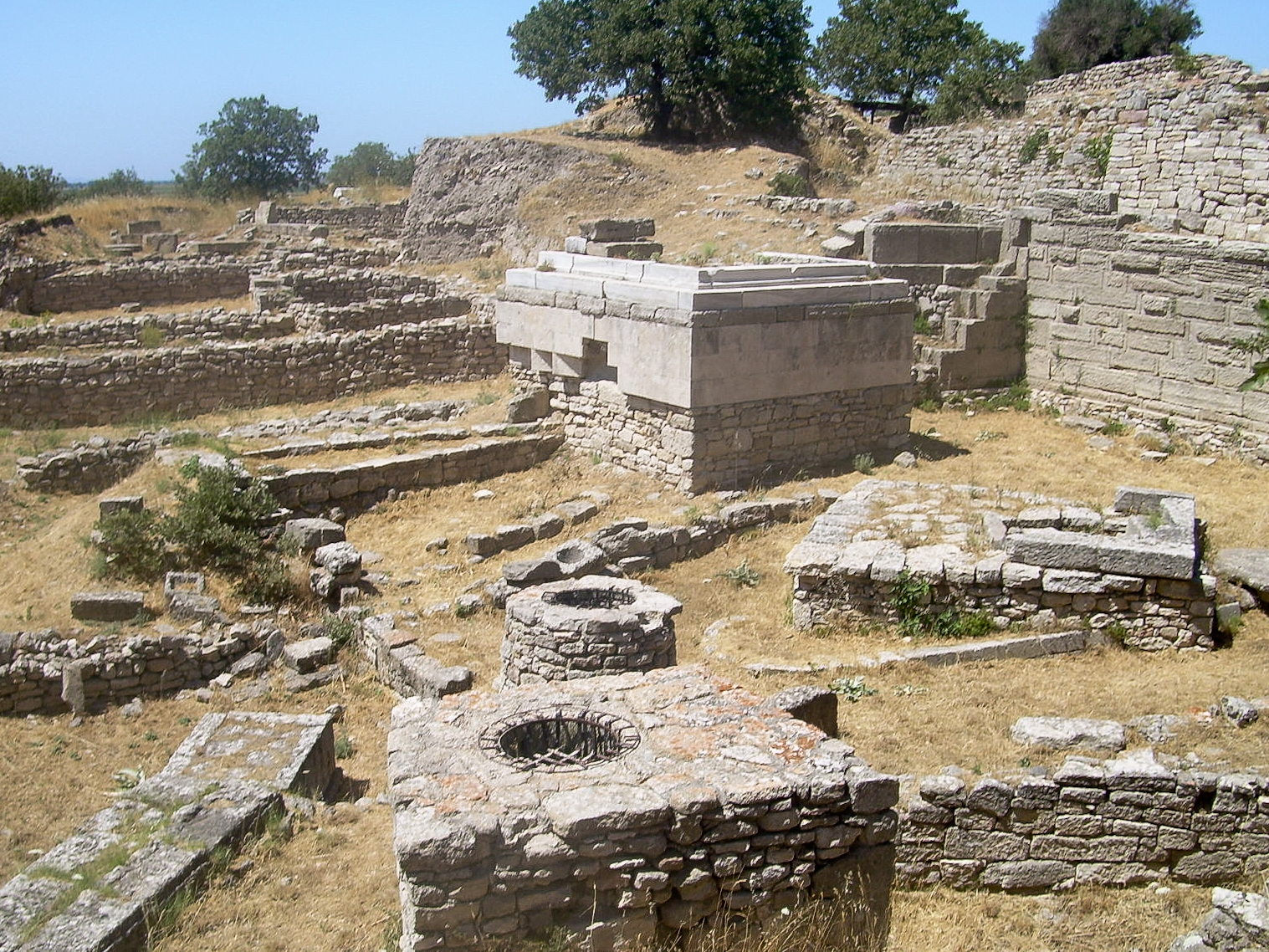
Archaeological site
[ edit ] Schematic of the site [ b ] The archaeological site of Troy consists of the hill of Hisarlık and the fields below it to the south. The hill is a tell , composed of strata containing the remains left behind by more than three millennia of human occupation. The primary divisions among layers are designated with Roman numerals , Troy I representing the oldest layer and Troy IX representing the most recent. Sublayers are distinguished with lowercase letters (e.g. VIIa and VIIb) and further subdivisions with numbers (e.g. VIIb1 and VIIb2). An additional major layer known as Troy 0 predates the layers which were initially given Roman numeral designations. The layers have been given relative dates by comparing artefacts found in them to those found at other sites. However, precise absolute dates are not always possible due to limitations in the accuracy of radiocarbon dating . Layer Dates Period [ c ] Troy 0 3600–3000 BC Neolithic and Early Bronze Age Troy I 3000–2550 BC Early Bronze Age Troy II 2500–2300 BC Early Bronze Age Troy III 2300–2200 BC Early Bronze Age Troy IV 2200–2000 BC Early Bronze Age Troy V 2000–1750 BC Early Bronze Age Troy VI 1750–1300 BC Middle Bronze Age and Late Bronze Age Troy VIIa 1300–1180 BC Late Bronze Age Troy VIIb 1180–950 BC Late Bronze Age and Dark Age Troy VIII 950–85 BC Classical and Hellenistic Troy IX 85 BCE–500 AD Roman


