TROY · OVERVIEW
Troy or Ilion was an ancient city located in present-day Çanakkale, Turkey. It is best known as the setting for the Greek myth of the Trojan War. The modern-day archaeological site, also known as Hisarlık, is open to the public as a tourist destination, and was added to the UNESCO World Heritage list in 1998.
LOCATION ·
39.95750, 26.23889
Archaeological site
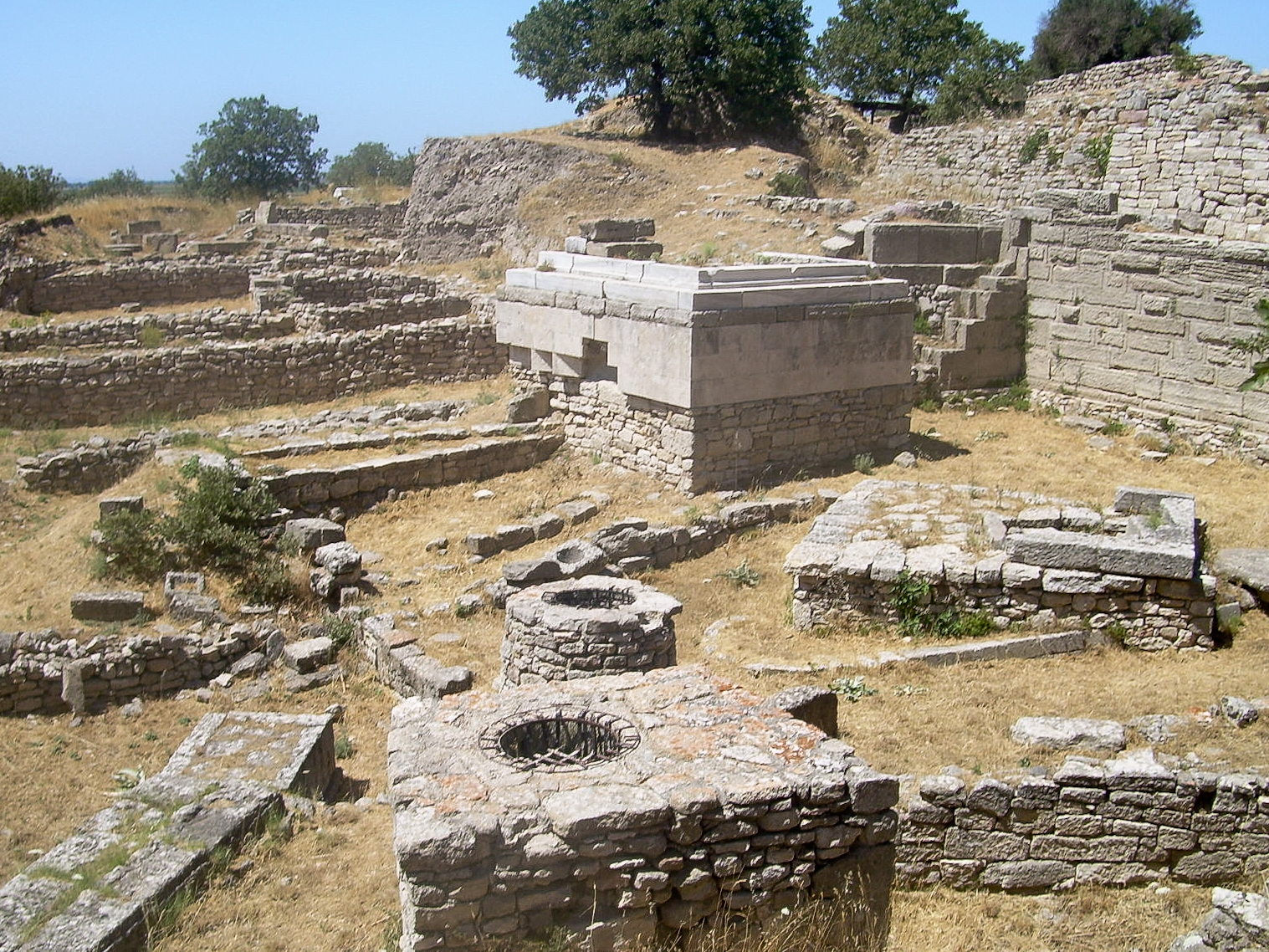
[ edit ] Schematic of the site [ b ] The archaeological site of Troy consists of the hill of Hisarlık and the fields below it to the south. The hill is a tell , composed of strata containing the remains left behind by more than three millennia of human occupation. The primary divisions among layers are designated with Roman numerals , Troy I representing the oldest layer and Troy IX representing the most recent. Sublayers are distinguished with lowercase letters (e.g. VIIa and VIIb) and further subdivisions with numbers (e.g. VIIb1 and VIIb2). An additional major layer known as Troy 0 predates the layers which were initially given Roman numeral designations. The layers have been given relative dates by comparing artefacts found in them to those found at other sites. However, precise absolute dates are not always possible due to limitations in the accuracy of radiocarbon dating . Layer Dates Period [ c ] Troy 0 3600–3000 BC Neolithic and Early Bronze Age Troy I 3000–2550 BC Early Bronze Age Troy II 2500–2300 BC Early Bronze Age Troy III 2300–2200 BC Early Bronze Age Troy IV 2200–2000 BC Early Bronze Age Troy V 2000–1750 BC Early Bronze Age Troy VI 1750–1300 BC Middle Bronze Age and Late Bronze Age Troy VIIa 1300–1180 BC Late Bronze Age Troy VIIb 1180–950 BC Late Bronze Age and Dark Age Troy VIII 950–85 BC Classical and Hellenistic Troy IX 85 BCE–500 AD Roman
SOURCE · Wikipedia · CC BY-SA
Troy 0
[ edit ] Troy 0 is a pre-Bronze Age layer known from limited finds of pottery sherds and wooden beams. It is tentatively dated to c. 3600–3500 BC but little is known about it. [ better source needed ]
SOURCE · Wikipedia · CC BY-SA
Troy I
[ edit ] Troy I's fortifications were the most elaborate in northwestern Anatolia at the time. Troy I was founded around 3000 BC on what was then the eastern shore of a shallow lagoon. It was significantly smaller than later settlements at the site, with a citadel covering less than 1 ha (2 acres). However it stood out from its neighbours in particular for its massive limestone fortifications, which were regularly renovated and strengthened. Defensive architecture would continue to be a distinctive characteristic in later periods, reflecting perennial security concerns at the vulnerable coastal site. Residents lived in attached houses made of stone and mudbrick. Some houses had a megaron layout, among which one room is notably larger than the others. Although the city plan is not entirely clear from its limited remains, the houses appear to have been oriented parallel to the southern walls. Artifacts from this era include dark-coloured handmade pottery, objects made of copper, as well as a monumental stone stele with a relief depicting an armed warrior. Troy I was founded as part of a consolidation of settlement in the area. Its founders came from nearby towns such as Kumtepe and Gülpınar , which had been part of an earlier network that had cultural and economic ties to the eastern Aegean and southeastern Europe. Troy itself appears to have maintained these connections, showing similarities to sites in Thessaly and southeastern Europe, as well as Aegean sites such as Poliochni in Lemnos and Thermi in Lesbos . Despite some connections to Anatolian sites including Bademağacı , it did not then have the close ties with central Anatolia seen later. Troy I was destroyed by fire around 2550 BC.
SOURCE · Wikipedia · CC BY-SA
Troy II
[ edit ] Troy II was built around 2550 BC. Although there is no evidence of a cultural break after the previous settlement, the new city had a very different character. It was twice the size of the preceding city, featuring a lower town as well as an expanded citadel divided into two precincts. These precincts, divided by colonnades , suggest growing socio-political stratification in Trojan society. At the centre were large megaron-style buildings around a courtyard , which was likely used for public events. One of these buildings, Megaron IIA, is the biggest-known building of its kind in the Aegean-Anatolian region. The citadel was protected by massive stone walls and towers topped with mud-brick superstructures. It was accessed via two ramps, one of which is well preserved and attracts attention from modern-day tourists. Because the city was not large enough to require two gates for practical purposes, some archaeologists have speculated that one of the gates was intended for ceremonial processions. The lower city was protected by a wooden palisade unlike any other known in that era. It was a complex structure nearly 3 metres wide, with interior buttresses and columns and beams secured in notches cut into the bedrock. Wheel-made pottery appears at the site for the first time, along with caches of treasures that attest to Trojan participation in networks of aristocratic competition. These items were made from amber imported from the Baltic region , carnelian imported from India and lapis imported from Afghanistan . Some of these items are strikingly similar to those found at sites such as Poliochni and Ur , leading some scholars to speculate that they may have been made by itinerant jewellers who worked routes covering much of the Ancient Near East. Troy II was destroy
SOURCE · Wikipedia · CC BY-SA
Troy III–V
[ edit ] " Schliemann's Trench ". Layers are marked with Roman numerals. Troy continued to be occupied between 2300 BC and 1750 BC. However, little is known about these several layers due to Schliemann 's careless excavation practices. In order to fully excavate the citadel of Troy II, he destroyed most remains from this period without first documenting them. These settlements appear to have been smaller and poorer than previous ones, though this interpretation could be merely the result of gaps in the surviving evidence. The settlements included a dense residential neighbourhood in the citadel. Walls from Troy II may have been reused as part of Troy III (c. 2350/2300 to 2200/2150 BC).
SOURCE · Wikipedia · CC BY-SA
Troy VI–VII
[ edit ] Troy VI–VII was a major Late Bronze Age city consisting of a steep fortified citadel and a sprawling lower town below it. It was a thriving coastal city with a considerable population, equal in size to second-tier Hittite settlements. It had a distinct Northwest Anatolian culture and extensive foreign contacts, including with Mycenaean Greece , and its position at the mouth of the Dardanelles has been argued to have given it the function of a regional capital, its status protected by treaties. Aspects of its architecture are consistent with the Iliad 's description of mythic Troy, and several of its sublayers (VIh and VIIa) show potential signs of violent destruction. Thus, these sublayers are among the candidates for a potential historical setting of those myths. Late Bronze Age Troy includes parts of the archaeological layers known as Troy VI and Troy VII. Troy VI was built c. 1750 BC . Its final sublayer, Troy VIh, was destroyed c. 1300 BC . The early sublayers of Troy VII were contemporary with the late period of Mycenaean culture and the Hittite Empire . The later layers were contemporary with the Greek Dark Ages and the Neo-Hittite states. Troy VI: c. 1750 – c. 1300 BC Troy VII: c. 1300 – c. 950 BC Troy VIIa: c. 1300 – c. 1180 BC Troy VIIb: c. 1180 – c. 950 BC Troy VIIb 1 : c. 1180 – c. 1100 BC Troy VIIb 2 : c. 1100 – c. 1050 BC Troy VIIb 3 : c. 1050 – c. 950 BC Troy VI and VII were given separate labels by early excavators, but scholarly consensus holds that the first several sublayers of Troy VII were in fact continuations of the earlier city. As a result, some researchers have suggested relabelling Troy VIIa as Troy VIi and Troy VIIb1 as Troy VIj, with Troy VII beginning at the sublayer standardly known as VIIb2. Although the substance of this proposal
SOURCE · Wikipedia · CC BY-SA